



Report overview
This report features 110 of the Australian Government’s most complex and strategically significant digital projects, involving a total investment of $12.9 billion. Note: This number and value of projects excludes projects that entered central oversight following the 2024–25 Mid-Year Economic and Fiscal Outlook (MYEFO) process, as well as any project data which has been withheld in the public interest (see Appendix for details).
To be included in this report, a project must:
- primarily rely on digital technologies to achieve its aims
- have been assigned a ‘tier’ rating, reflecting that it is a ‘major’ project sufficiently complex and strategically significant to require central oversight by the DTA.
While this report includes most high-profile projects, it does not cover all projects. For example, some projects are not sufficiently complex or strategically significant to receive a tier rating. Others have only recently been funded and will feature in future reports.
There are 3 possible tier ratings for digital projects, with higher tiered projects subject to increased levels of central monitoring and oversight:
- Tier 1 projects are the Australian Government’s most complex and strategically significant digital projects.
- Tier 2 projects are also complex and strategically significant, but with smaller scope, lower criticality and/or lower cost than Tier 1 projects.
- Tier 3 projects are significant investments that generally represent lower risk.
Australians now have unprecedented transparency into the performance of the government’s digital projects
Work to improve assurance of digital projects is ensuring reliable assessments of delivery confidence are regularly undertaken. These assessments show most projects are on track to deliver expected outcomes on budget and on schedule.

CHART GOES HERE
The distribution of project by total budget highlights the diversity of projects underway across the Australian Government (Projects in order of smallest to largest budget)
IMAGE GOES HERE
Image description
PLACEHOLDER
OffIMAGE GOES HERE
Image description
PLACEHOLDER
OffIMAGE GOES HERE
Image description
PLACEHOLDER
OffIMAGE GOES HERE
Image description
PLACEHOLDER
OffProjects reporting Medium or lower delivery confidence
While many projects are on-track, some projects are reporting lower levels of delivery confidence
Projects reporting Medium or lower delivery confidence
| Total projects (Tier 1 and 2) | 62 |
| Number with Medium or Lower delivery confidence | 23 |
| Percentage of total projects with Medium or lower delivery confidence | 37.1% |
| Total budget of projects with Medium or lower delivery confidence | $3.5 billion |
| Tier 1 Projects with Medium or lower delivery confidence | 45.0% |
| Tier 2 Projects with Medium or lower delivery confidence | 33.3% |
As this table shows, a higher proportion of Tier 1 projects (45.0%) are reporting a delivery confidence of Medium or below compared to Tier 2 projects (33.3%), likely reflecting the added risks and complexities inherent to these projects.
Common themes among projects rated Medium or lower are:
- dependencies on changes to, or introduction of, new legislation
- the complex nature of the technological solutions being implemented – including where integration of systems across organisations and even jurisdictions is required to achieve outcomes
- where digital transformation is occurring concurrent with major organisational changes, or at a pace the organisation is struggling to sustain (e.g., due to multiple concurrent digital projects putting pressure on an agency’s enterprise capability).
- challenges attracting and retaining staff with the required skills including in digital disciplines such as cybersecurity, as well as in project/program management disciplines such as benefits, change, risk, budget management, and integrated scheduling.
Projects reporting lower levels of delivery confidence are generally challenged by more than one of these themes. As noted in the July 2023 Review of the Modernising Business Registers Program, ‘the difficulty of effectively implementing a digital and ICT transformation project increases exponentially with each additional layer of complexity’.[1]
[1] The Australian Government the Treasury, Independent Review into Modernising Business Registers, p. 338.
Reducing risk through robust assurance and governance
Parallel development of legislation and digital capabilities can lead to significant delivery risks, including budget overruns, delays and, in extreme cases, project failures. Sometimes urgent factors make this concurrent work necessary, but where this occurs the associated risk must be managed carefully.
For high-risk digital projects, robust assurance and governance are crucial. The DTA seeks to mitigate risk by adding central funding and governance controls. An example is recommending the government quarantine part or all project funding, releasing it upon successful early discovery work and other proof points that indicate likely successful delivery.
Changes in delivery confidence
The government’s digital projects are being delivered against a backdrop of rapid and continuous technological change. This dynamic environment is reflected in the changes in delivery confidence ratings over the past year as projects move through different stages in their development.
Understanding overall changes in delivery confidence to target engagement and reforms
Reforms supporting success
Ensuring digital projects deliver expected benefits for Australians on time and on budget sits at the heart of each of the reforms highlighted throughout this report.
How digital projects are monitored and supported from the centre of government
In the past year, more projects have come under central monitoring and oversight as part of the Australian Government’s Digital and ICT Investment Oversight Framework (IOF).
This world-class framework is designed to ensure digital projects are strategically aligned, carefully prioritised, meet digital policies and standards, and realise expected benefits for Australians.
The IOF starts with setting a clear strategic direction, which is then reinforced throughout the lifecycle of project design, funding and implementation. Throughout this lifecycle, best-practice digital policies and standards set clear requirements with agencies supported to meet these requirements by the DTA.
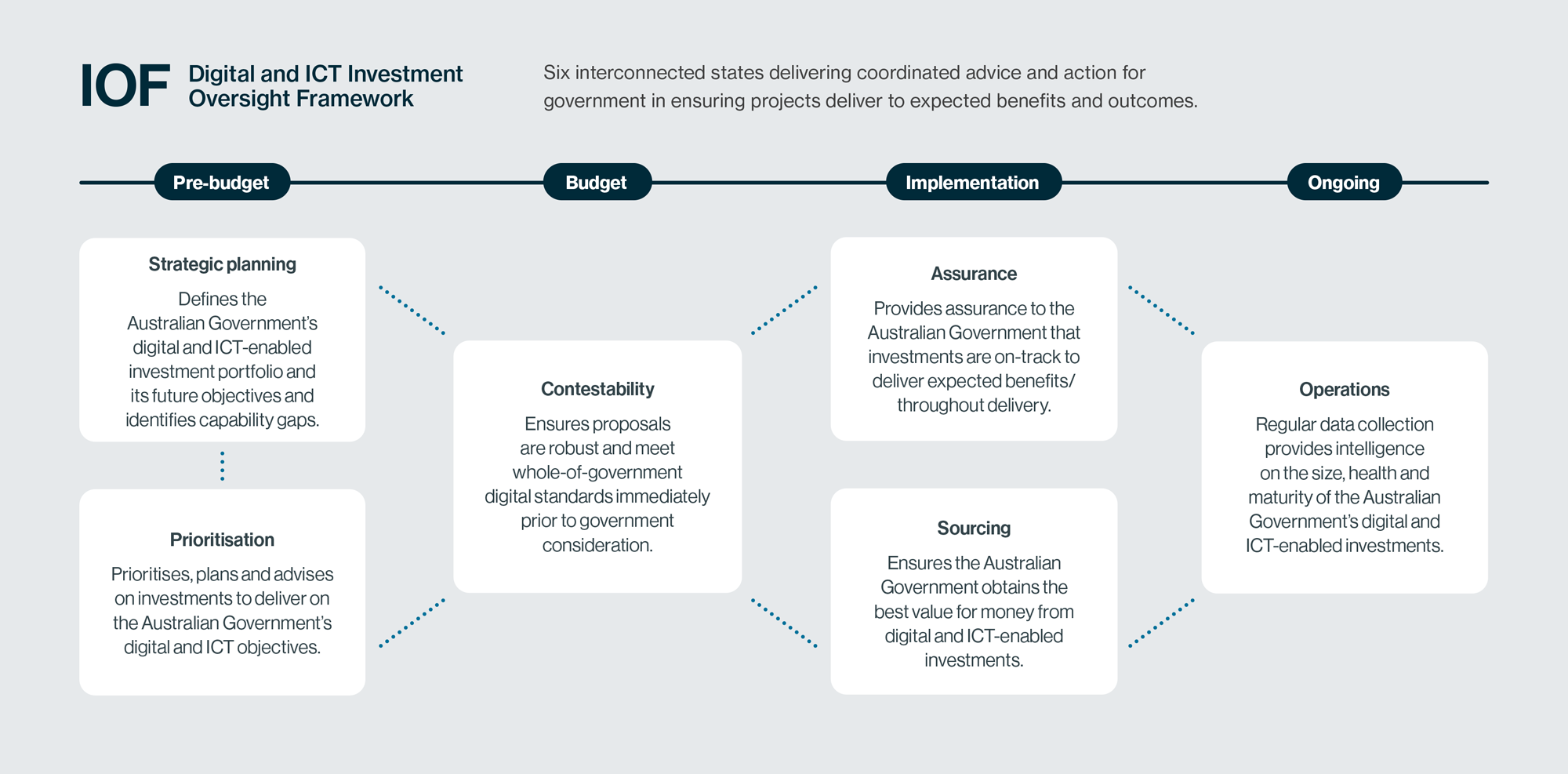
Image description
IOF Digital and ICT Investment Oversight Framework.
Six interconnected states delivering coordinated advice and action for governmentin ensuring projects deliver to expected benefits and outcomes. The diagram shows four headlines with various states of the IOF below them as subheadings.
- Image headline: Pre-budget
- Subheading: Strategic planning: Defines the Australian Government’s digital and ICT-enabled investment portfolio and its future objectives and identifies capability gaps.
- Subheading: Prioritisation: Prioritises, plans and advises on investments to deliver on the Australian Government’s digital and ICT objectives.
- Image headline: Budget
- Subheading: Contestability: Ensures proposals are robust and meet whole-of government digital standards immediately prior to government consideration.
- Image headline: Implementation
- Subheading: Assurance: Provides assurance to the Australian Government that investments are on-track to deliver expected benefits/ throughout delivery.
- Subheading: Sourcing: Ensures the Australian Government obtains the best value for money from digital and ICT-enabled investments.
- Image headline: Ongoing
- Subheading: Operations: Regular data collection provides intelligence on the size, health and maturity of the Australian Government’s digital and ICT-enabled investments
Reforms supporting success – enabling project success through good assurance
Since 2021, the Australian Government has invested in strengthening central oversight of digital projects. This central oversight works to ensure best practice is systematically applied as digital projects are designed and delivered across agencies. By driving the adoption of best practice, central oversight plays a key role in giving each digital project the best chance of success.
The Assurance Framework for Digital and ICT Investments mandates global best practice in the use of assurance for digital projects. While assurance doesn’t in itself deliver outcomes, effective assurance is critical to good governance and decision-making. All projects in this report are subject to the Assurance Framework and must apply its ‘key principles for good assurance’. These principles draw on global best practice and, when applied effectively, provide confidence that digital projects will achieve their objectives, without leading to excessive levels of assurance.
The Assurance Framework also includes escalation protocols to support agencies to resolve delivery challenges digital projects might encounter. Central oversight of assurance also ensures that lessons learned from across digital projects are systematically incorporated into the design and delivery of future projects to reduce the risk of delivery issues arising in future.
Reforms supporting success – ensuring digital projects are well designed
The DTA works with agencies to ensure robust and defensible proposals for spending on all new digital projects.
Each proposal must align with the government’s strategies, policies and best practice digital standards as part of the Digital Capability Assessment Process (DCAP).
For complex, high-risk and high-cost digital projects, the DTA offers additional support through the ICT Investment Approval Process (IIAP). This involves working with agencies to develop and mature implementation planning to support success. A comprehensive business case must clearly demonstrate the need for funding, based on thorough policy development, a well-planned approach to delivery and mechanisms for reviewing project progress. This process aids government decision-making on whether to fund large and complex digital project proposals.
The DTA’s digital policies and standards codify best practice and ensure digital projects are positioned to succeed
The policies that apply to digital projects in the Australian Government are constantly being reviewed and updated. This is necessary to ensure they best support agencies in delivering the world-class data and digital capabilities needed to support the missions set out in the Data and Digital Government Strategy.
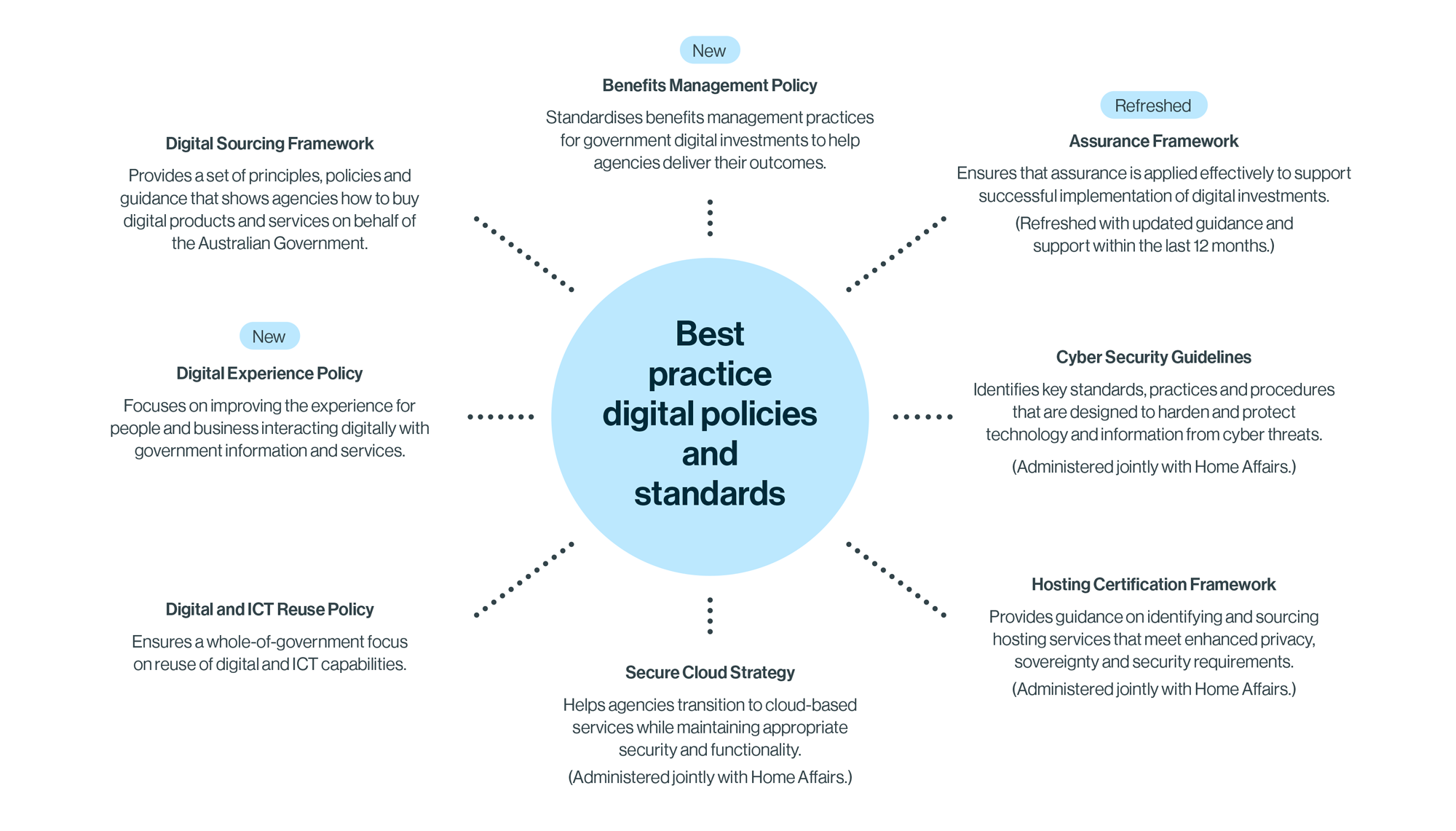
Image description
The image shows a central circle with lines leading off to the subheadings.
Image headline (in the centre): 'Best Practice Digital Policies and Standards'
Sub headings:
- Secure Cloud Strategy
- Helps agencies transition to cloud-based services while maintaining appropriate security and functionality.
- (Administered jointly with Home Affairs)
- Hosting Certification Framework
- Provides guidance on identifying and sourcing hosting services that meet enhanced privacy, sovereignty and security requirements.
- (Administered jointly with Home Affairs
- Cyber Security Guidelines
- Identifies key standards, practices and procedures that are designed to harden and protect technology and information from cyber threats.
- (Administered jointly with Home Affairs).
- Assurance Framework (Refreshed)
- Ensure that assurance is applied effectively to support successful implementation of digital investments.
- (Refreshed with updated guidance and support within the last 12 months)
- Benefits Management Policy (New)
- Standardises benefit management practices for government digital investments to help agencies deliver their outcomes.
- Digital Sourcing Framework
- Provides a set of principles, policies and guidance that shows agencies how to buy digital products and services on behalf of the Australian Government.
- Digital Experience Policy (New)
- Focuses on improving the experience for people and businesses interacting digitally with government information and services.
- Digital and ICT Reuse Policy
- Ensures a whole of government focus on reuse of digital and ICT capabilities.