



Social services
Department of Social Services
| Project name | DCA 2024 | DCA 2025 | Delivery status | Total budget ($ million) | Digital budget ($ million) | Project end date | Project description |
|---|---|---|---|---|---|---|---|
| New Specialist Disability Employment Program | Medium-High | Active | 227.6 | 166.3 | 31 Aug 2027 | This project is to support/enable the reform of Employment Services for people with disability. The New Specialist Disability Employment Program will be underpinned by an uplift and modernisation of the ICT system, to streamline and digitise administrative processes to support an improved user experience. The technology solution will ensure future services and policy settings are supported by a fit-for-purpose, tailored digital platform that meets the needs of all job seekers, providers, and employers. This includes providing more intuitive, accessible, and secure interfaces for service providers who enable individualised and flexible support for job seekers. | |
| Next Phase of the National Disability Data Asset (NDDA) | Medium | Medium | Active | 87.7 | 53.6 | 30 Jun 2027 | The project will establish an enduring National Disability Data Asset (NDDA) of linked, de-identified data, leveraging multiple Australian, state and territory government service systems and surveys to provide insights on the outcomes of people with disability and their pathways through services. |
National Disability Insurance Agency
| Project name | DCA 2024 | DCA 2025 | Delivery status | Total budget ($ million) | Digital budget ($ million) | Project end date | Project description |
|---|---|---|---|---|---|---|---|
| Crack Down on Fraud Program | Medium | Active | 194.3 | 145.7 | 31 Dec 2025 | The Crack Down on Fraud program will boost fraud‑detecting IT systems to better protect monies allocated to Australians living with disability who are on the NDIS. The investment will complement the work of the Fraud Fusion Taskforce to respond to areas of vulnerability in NDIS systems. The program includes a number of ICT improvements that will be implemented progressively and are designed to make it easier to get it right, and harder to get it wrong for everyone engaging with the NDIS. |
NDIS Quality and Safeguards Commission
| Project name | DCA 2024 | DCA 2025 | Delivery status | Total budget ($ million) | Digital budget ($ million) | Project end date | Project description |
|---|---|---|---|---|---|---|---|
| Data and Regulatory Transformation (DART) Program | Medium | Active | 160.3 | 85.9 | 30 Jun 2028 | The DART Program will transform the NDIS Quality and Safeguards Commission data and technology systems to support new ways of working that will sustainably address issues experienced by NDIS participants, providers and workers. The DART Program aims to establish essential, risk‑based regulatory capabilities that meet the Commission’s current and future legislative obligations, safeguard participants, ensure market quality, and proactively manage compliance. |
Services Australia
| Project name | DCA 2024 | DCA 2025 | Delivery status | Total budget ($ million) | Digital budget ($ million) | Project end date | Project description |
|---|---|---|---|---|---|---|---|
| Health Delivery Modernisation | Medium-High | Medium-High | Active | 418.7 | 176.4 | 30 Jun 2025 | The Health Delivery Modernisation Program continues to stabilise, modernise and transform the health payments system that underpins Medicare, the Pharmaceutical Benefits Scheme (PBS) and other health related programs. The Program is delivering new digital health services and is establishing new health transformation capabilities to strengthen and modernise digital health across Australia’s healthcare settings, platforms and systems. |
| Project name | DCA 2024 | DCA 2025 | Delivery status | Total budget ($ million) | Digital budget ($ million) | Project end date | Project description |
|---|---|---|---|---|---|---|---|
| Safely Connecting Australians with Support | High | Active | 29.8 | 18.7 | 30 Jun 2025 | Enhancements to the myGov platform to continue to respond to the findings of the Critical National Infrastructure myGov User Audit and advice from the independent advisory board, including enhancements to the myGov support tool, strengthening myGov fraud detection capabilities, improving the myGov inbox and other communication tools and supporting users to better secure their myGov accounts. |
| Project name | Delivery status | Total budget ($ million) | Digital budget ($ million) | Project end date | Project description |
|---|---|---|---|---|---|
| Energy Bill Relief Fund (EBRF) – ICT Build for Services Australia | Closed | 8.7 | 3.8 | 01 Jun 2024 | The Australian Government has partnered with states and territories through the Energy Price Relief Plan to deliver temporary relief on power bills to eligible Australian households and small businesses. Treasury is the policy owner and project lead. Services Australia was engaged to provide a temporary Centrelink Confirmation eServices (CCeS) – a secure online service for businesses to confirm a customer’s entitlement to a concession, rebate or service. The CCeS was delivered and then decommissioned on 30 June 2024, with the project delivered successfully and on schedule. |
| Phishing Resistant myGov Login Credentials | Closed | 5.6 | 3.3 | 30 Jun 2024 | This project introduced phishing resistant sign in credentials (Passkeys) into the myGov Platform. |
| Response to Services Australia Budget and Efficiency Review – CUSP | Active | NFP | NFP | 30 Jun 2025 | The Cyber Security Uplift Projects (CSUP) was established to address immediate agency cyber security risk and improve its cyber security maturity. |
| Services Australia Improved Safety for Staff and Customers Phase 2 | Active | 314.5 | 103.8 | 30 Jun 2026 | The Security Risk Management Review Program will implement all 44 Security Risk Management Review recommendations in full with funding committed through the 2023–24 Mid-Year Economic and Fiscal Outlook and 2024–25 Budget and internally committed agency resources. The Program, comprising 7 projects for government funded initiatives, will strengthen security and safety measures for Services Australia staff and customers. |
| Strengthening Medicare – Chronic Wound Consumables Scheme for Patients with Diabetes | Active | 16.7 | 10.4 | 30 Jun 2025 | This project is improving the management of wounds for patients in primary care settings by providing education and training for healthcare professionals and providing fully subsidised wound consumable products to people with chronic wounds. The pilot phase of this project is limited to people with a chronic wound and diabetes who are aged 65 and over (or aged 50 and over for First Nations people). If the pilot is successful, the program may be expanded to all Australians with chronic wounds. |
Treasury
Australian Bureau of Statistics
| Project name | DCA 2024 | DCA 2025 | Delivery status | Total budget ($ million) | Digital budget ($ million) | Project end date | Project description |
|---|---|---|---|---|---|---|---|
| Big Data Timely Insights (BDTI) Phase 2 | Medium-High | Medium | Active | 224.3 | 132.4 | 30 Jun 2030 | BDTI Phase 2 provides a pathway off legacy ICT systems, ensuring the Australian Bureau of Statistics (ABS) maximises the reuse of new tools and lessons across the organisation. The project involves rebuilding and securing the Consumer Price Index (CPI) ICT system, delivering a complete monthly measure of the CPI, building the business statistics production process in the cloud, replacing the legacy Business Register with an expanded Business Characteristics Asset in the cloud, and industrialising the ABS cloud environment. |
| Project name | DCA 2024 | DCA 2025 | Delivery status | Total budget ($ million) | Digital budget ($ million) | Project end date | Project description |
|---|---|---|---|---|---|---|---|
| 2026 Census of Population and Housing | Medium-High | Active | 726.5 | 164.4 | 30 Dec 2027 | The 2026 Census of Population and Housing will be Australia’s 19th national Census. The Census and Statistics Act 1905 (Part II, S8) requires the ABS to conduct a Census every 5 years. The Census provides the base for official counts of Australians and the dwellings in which they live. It is a snapshot of the economic, social and cultural make-up of the nation, and tells the story of how Australia is changing over time. |
| Project name | Delivery status | Total budget ($ million) | Digital budget ($ million) | Project end date | Project description |
|---|---|---|---|---|---|
| Modernising ABS Operations: Essential Investments - Data Acquisition Reform | Closed | 17.5 | 11.0 | 31 Dec 2024 | The ABS’s Data Acquisition Modernisation program
|
Australian Competition and Consumer Commission
| Project name | DCA 2024 | DCA 2025 | Delivery status | Total budget ($ million) | Digital budget ($ million) | Project end date | Project description |
|---|---|---|---|---|---|---|---|
| National Anti-Scam Centre | Not reported | Medium | Active | 80.1 | 43.2 | 31 Jul 2026 | The NASC is a world-leading initiative to make Australia the hardest country for scammers to victimise citizens in. It will disincentivise scammers from targeting Australia and result in significantly less scam attempts. |
| Working Smarter Program (WSP) | Medium-High | Medium-High | Closed | 41.4 | 41.4 | 30 Jun 2024 | The investment will stabilise the Australian Competition and Consumer Commission’s ICT infrastructure to support the installation of fit-for-purpose business and corporate enabling applications and systems and introduce data analytics capabilities. |
Australian Prudential Regulation Authority
| Project name | DCA 2024 | DCA 2025 | Delivery status | Total budget ($ million) | Digital budget ($ million) | Project end date | Project description |
|---|---|---|---|---|---|---|---|
| GUIDE Program | Medium-High | Active | 73.2 | 73.2 | 30 Jun 2028 | The Governance Uplift and Investment in Data Enablement (GUIDE) program is a multi-year strategic investment in Australian Prudential Regulation Authority (APRA) data capabilities and security position, including APRA’s supervision management system. By investing in data governance, security and infrastructure, the program aims to ensure that APRA can continue to effectively fulfil its mandate, mitigate risks and support the stability and resilience of the Australian financial system. |
Australian Securities and Investments Commission
| Project name | DCA 2024 | DCA 2025 | Delivery status | Total budget ($ million) | Digital budget ($ million) | Project end date | Project description |
|---|---|---|---|---|---|---|---|
| Digital Transformation X (DTx) – under Stabilisation of ASIC Business Registers and Regulatory Systems | Medium-High | Active | 45.5 | 45.5 | 30 Jun 2028 | The DTx Cyber Security Initiative will enhance existing cyber capabilities to secure the Australian Securities and Investments Commission (ASIC) existing and future networks, systems and data. The program will deliver a range of capabilities that secure ASIC regulatory systems and uplift maturity against the Essential 8. | |
| RegistryConnect Program | Medium-High | Active | 154.7 | 106.1 | 31 Dec 2029 | ASIC’s RegistryConnect Program will deliver reliable, secure, trusted, and efficient registry services to support the economy for the benefit of all Australians. The program’s objectives include: stabilising Registry technology to increase the security, reliability, and performance of its registers; modernising and uplifting the registers, user channels and interfaces; improving the quality and integrity of registry data; achieve policy and law reform; and developing enduring capabilities. |
| Project name | Delivery status | Total budget ($ million) | Digital budget ($ million) | Project end date | Project description |
|---|---|---|---|---|---|
| Fighting Investment Scams | Closed | 17.6 | 1.5 | 30 Sep 2024 | The Fighting Investment Scams project aims to protect Australian consumers from investment scams by proactively taking down investment scam and phishing websites. The project covers the ongoing use of a website takedown service to remove a variety of investment scams. |
Australian Taxation Office
| Project name | DCA 2024 | DCA 2025 | Delivery status | Total budget ($ million) | Digital budget ($ million) | Project end date | Project description |
|---|---|---|---|---|---|---|---|
| Counter Fraud Program | Medium-High | Active | 187.0 | 68.4 | 30 Jun 2028 | The Counter Fraud Program will strengthen Australian Taxation Office (ATO) ability to prevent, detect, contain, and bring consequence to fraud and financial crime against the tax and superannuation systems. | |
| Modernising ATO IT Systems (MATOS) Program | Medium | High | Closed | 42.1 | 30.8 | 30 Jun 2024 | The Modernising ATO IT Systems (MATOS) Program first tranche, Insights and Intelligence will modernise the ATO’s strategic IT application platform as the first step to unlock the full data potential of the ATO by purposefully leveraging data, analytics and automation to maximise the long-term sustainable economic value to Australia from the tax and superannuation system. |
| Payday Super - Superannuation Guarantee Reform (Unpaid Super) | Not reported | Low | Active | 352.3 | 262.2 | 30 Jun 2028 | The Payday Super project will address the systemic issue of unpaid and underpaid super guarantee by employers by moving the obligation to pay from a quarterly to payday cycle. The ATO will be funded to build and improve data matching capabilities to match employers’ payroll data with super contribution data, providing the ATO with near real-time visibility as to whether employers have met their obligations. The government will also redesign the super guarantee legislation in line with the move to payday super. Penalties and charges will reflect the serious nature of unpaid or underpaid super guarantee and will be recalibrated to encourage prompt rectification of non-payment with scalable consequences to deter severe or repeated non-compliance. |
| Project name | DCA 2024 | DCA 2025 | Delivery status | Total budget ($ million) | Digital budget ($ million) | Project end date | Project description |
|---|---|---|---|---|---|---|---|
| Better Targeted Superannuation Concessions | Not reported | Medium-High | Active | 45.5 | 16.9 | 30 Jun 2027 | The Better Targeted Superannuation Concessions measure was announced by the Australian Government on 28 February 2023, with further authority and detail provided in the 2023–24 Budget. This project is enabling the delivery of this measure with first assessments to be issued in the first half of the 2026–27 financial year. |
| Implementation Of A Global Minimum Tax And A Domestic Minimum Tax (Pillar 2) | Medium | Medium | Active | 110.5 | 33.6 | 30 Jun 2027 | On 8 October 2021, Australia, as a member of the Inclusive Framework, agreed along with more than 130 other jurisdictions, to a Statement that set out the framework for Pillar 2 (the Global Anti-Base Erosion [GloBE] Model Rules). Australia is an OECD member, and as a member of the OECD/G20 Inclusive Framework on Base Erosion and Profit Shifting, and active member of the Forum on Tax Administration and implementing the Pillar 2 will further strengthen Australia’s ability to address multinational tax avoidance. The government investment provides the ATO with the means to ensure resources are available for the ICT and data requirements to implement and administer this measure, as well as ensuring a strong ongoing compliance, advice and education focus to support the in-scope population. At the time of preparing this report, this project is subject to the escalation protocols set out in the Assurance Framework for Digital and ICT-enabled Projects. These protocols are designed to support agencies in the timely resolution of delivery challenges. |
| Project name | Delivery status | Total budget ($ million) | Digital budget ($ million) | Project end date | Project description |
|---|---|---|---|---|---|
| Cyber Security Program (previously known as Building Cyber Resilience) | Active | 108.1 | 108.1 | 31 Dec 2026 | The Program focuses on uplifting Essential 8 to Maturity Level 2, providing fit for purpose security services to protect the ATO’s digital ecosystem. The Program’s outcomes will increase the ATO’s cyber maturity through the delivery of enhanced cyber capabilities and technologies. |
Department of the Treasury
| Project name | DCA 2024 | DCA 2025 | Delivery status | Total budget ($ million) | Digital budget ($ million) | Project end date | Project description |
|---|---|---|---|---|---|---|---|
| Foreign Investment Digital Transformation (FIDT) | Medium | Medium | Active | 93.6 | 66.1 | 30 Jun 2025 | The Treasury is undertaking a transformation program to support the Government’s foreign investment framework and replace the current Foreign Investment Management System to deliver a fully functional end-to-end case management system, a register of foreign ownership of Australian assets and improved analytics capability. At the time of preparing this report, this project is subject to the escalation protocols set out in the Assurance Framework for Digital and ICT-enabled Projects. These protocols are designed to support agencies in the timely resolution of delivery challenges. |
| Project name | Delivery status | Total budget ($ million) | Digital budget ($ million) | Project end date | Project description |
|---|---|---|---|---|---|
| Payment Times Reporting Scheme (PTRS) – ICT Infrastructure rebuild | Active | 8.9 | 8.9 | 31 Dec 2025 | This system rebuild supports improved reporting following reforms to the Payment Times Reporting Scheme. A modern portal will streamline and reduce the regulatory burden of reporting and the public can search and interrogate payment times information, including the best and worst paying large businesses using new dashboards. Increasing the transparency of large businesses’ payment performance towards their small business suppliers can incentivise fairer and faster payments to small business. |
Veterans' affairs (part of the Defence portfolio)
Department of Veterans' Affairs
| Project name | DCA 2024 | DCA 2025 | Delivery status | Total budget ($ million) | Digital budget ($ million) | Project end date | Project description |
|---|---|---|---|---|---|---|---|
| ObjectStar database migration to DB2 | Medium-High | Active | 18.2 | 18.2 | 30 Jun 2025 | This project de-risks the legacy application development environment (ObjectStar) to migrate data onto a secure and modern solution. The legacy development environment contains highly complex infrastructure and rules database, underpinning 56 applications that enable critical functions to veteran service delivery. This measure is consistent with Department of Veterans’ Affairs (DVA) priorities to address the claims backlog and improve the claims administration system. |
| Project name | DCA 2024 | DCA 2025 | Delivery status | Total budget ($ million) | Digital budget ($ million) | Project end date | Project description |
|---|---|---|---|---|---|---|---|
| Modernisation to reduce wait times to access support and services | Not reported | Medium- High | Closed | 87.2 | 87.2 | 30 Nov 2024 | This proposal seeks to ensure the DVA’s technology and digital channel delivery functions effectively to support improved claims administration and claims backlog elimination; and to address the unacceptable level of enterprise risk associated with the legacy technology that underpins DVA’s financial management capability. |
| Replacement of the Departmental On Line Accounting and Reporting System (DOLARS) | Not reported | Medium | Active | 89.3 | 89.3 | 15 Dec 2025 | This project directly addresses key issues underpinning the Royal Commission’s recommendations by proposing a range of measures to address the unacceptable level of enterprise risk associated with the legacy technology underpinning DVA’s financial management capability (DOLARS) and ensure DVA’s technology and digital channel delivery functions support improve claims administration and claims backlog elimination. |
| Project name | Delivery status | Total budget ($ million) | Digital budget ($ million) | Project end date | Project description |
|---|---|---|---|---|---|
| Digital Resilience Roadmap – Piloting and Modernising DVA’s Case Management and Workflow Capability | Active | 8.4 | 8.4 | 31 Dec 2025 | This project seeks to pilot a modern Enterprise Case Management Solution (ECMS) for DVA. It will trial a new clinical case management solution to support veterans and their families through counselling services. This proposal enables DVA to continue to contribute and deliver on the Australian Government’s response to Recommendation 3 of the Interim Report to the Royal Commission by improving the administration of the claims system. |
Environmental sector
Since February 2024, the resources and environment sector experienced a net increase by 7 projects and growth of investment by $3.4 billion.
This is largely attributed to one 35 year-long project that intends to secure the resources needed for Australia’s transition to net-zero. [SC16] The Government sector experienced a net growth of $1.2 billion, largely related to investment in Australia’s 19th national Census and the replacement of legacy systems to modernise Australia’s electoral systems.
Off
Healthcare and aged care
Digital services are improving the health of Australians, including the care of older people. The 15 active projects in this sector, with a combined value of $1.9 billion, [CL19] reflect the recent increase in government investment in this area.
Most of the funding ($1.3 billion) is for 9 projects to improve the aged care sector by implementing recommendations following the Royal Commission into Aged Care Quality and Safety in 2021. This includes:
- [TG20] improving ICT capabilities of federal agencies to enable more effective regulation of the aged care industry
- delivering a modernised system that supports aged care service providers to provide the high quality, safe care that older people deserve
- ensuring nurses are available at all residential care facilities and all aged care workers are registered on a national register
- supporting the different levels of independence and care required by older Australians.
The remaining 6 projects ($6 million) are delivering new and improved health services, completing digital transformation of internal systems, and producing better online portals for Australians to access services.
Off
Safety of Australians
The government is protecting vulnerable Australians by investing in law enforcement and online safety through 15 projects with a combined value of $2.0 billion [CL21] being delivered across 11 Commonwealth agencies.
These projects are safeguarding Australia by:
- improving access to cross-border information and real-time risk data on dangerous individuals and organisations
- enhancing data matching capability to reduce investigation time and improve the ability to combat organised crime
- contributing to a national view of policing information and criminal intelligence
- using machine learning and artificial intelligence to significantly improve Australia’s efforts to combat illicit activities such as money laundering and unauthorised imports
- developing comprehensive registries and data lakes [CL22] [AC23] [TS24] to store historical information to allow authorities to identify suspicious activity faster
- automating border clearance and cargo processes to simplify government services while also improving security alerts and risk information.
Other investments are improving the use of data to combat the growing threat of scams targeting Australians (see case study on page xx), protecting myGov users by strengthened measures to prevent phishing attacks (see case study on page xx) and targeting disability insurance fraud (see case study on page xx).
Off
Resources and the environment
Australia’s natural environment is vast and varied – home to different climates and unique native plants and animals, and subject to extreme weather events like droughts and floods. The government is investing $4.2 billion into 21 initiatives [CL25] [CY26] to help protect and restore Australia’s environment.
This includes a long-term project ($3.4 billion) to comprehensively map Australia’s natural resources, including critical minerals and groundwater, to support the transition to net zero and enable responsible management of all resources.
Eight projects (over $535 million[CL27] ) are leveraging data and technology to enable rapid action to address environmental changes.
Data, information and analytics are being used to better manage and protect Australia’s natural heritage and streamline work on environmental and climate risk assessment projects.
Significant investment is also supporting emissions reduction and renewable energy mechanisms. A further 5 projects (over $104 million) are building the skills and data infrastructure needed to manage and monitor energy, water and diesel exhaust fluid markets and plan for future supply and demand.
Another project (over $104 million) is helping to improve the management of water resources and responses to climate change impacts in the Murray-Daring Basin.
A previous investment in this sector, which concluded in June 2024, modernised and secured critical climate and weather data services (see case study on page xx).
Off
Education and employment
Education and employment underpin achievement and prosperity in Australia. The government is investing $512.5 million across 11 projects to reform this sector by removing barriers, enhancing outcomes and creating more efficient processes.
Digital projects in this sector are using digital tools to enhance childcare subsidy administration, automate workflows, back up records, and connect service providers – improving quality and capacity.
Student loans enable further education in Australia. Initiatives are enhancing data quality and insights through organised information storage and automated processes and supporting more effective distribution of resources and a more efficient student loans system through integration of data.
Projects related to employment services are simplifying the user experience and reducing system strain. Centralised data management is enabling effective tracking of employment trends, driving data-driven improvements. Consolidating services onto a single platform will enhance outcomes and reduce operational costs.
The modernisation of Australia’s vocational education management system aims to expand the workforce. Initiatives are overhauling the administration of VET Student Loans and replacing outdated systems, which is essential to upscale apprenticeship programs and services.
Off
Tax and superannuation
An efficient tax and superannuation system aims to reduce unnecessary costs on the economy, while raising revenue to fund critical government services. The government is investing in 5 major projects in this sector, with a combined value of $803.4 million.
One project in this sector is helping to safeguard workers’ entitlements and address the systemic issue of employers not paying or underpaying Superannuation Guarantee (SG) entitlements. Another project is improving data availability and access to tools to improve the efficiency and effectiveness of Australian Taxation Office (ATO) staff. This will enable enhanced data matching to minimise the need for staff to manually identify unpaid SG, while also reducing the reporting burden for employers.
Investment in new ATO systems has streamlined the process of managing tax requirements, supporting the introduction of lower tax concessions for people with large total superannuation balances. Reforms aim to enhance the robustness, equity and sustainability of the retirement savings system, benefiting a broader range of Australians and supporting retirees. Further initiatives are enhancing the ATO’s capability to defend against cyber attacks, ensuring the confidentiality, integrity and availability of internal systems and data.
Another project is making sure the ATO can meet the ICT and data requirements to support a global initiative to tackle multinational tax avoidance.[CL28] [CY29]
Some of the technological foundations for such projects within the tax and super sector were laid through a previous ATO data centre project (see case study on page xx).
Off
Industry, infrastructure and business
A primary role of government is improving quality of life for Australians through investing in domestic productivity. To this end, the government is investing $657.9 million across 11 projects in the industry, infrastructure and business sector.
The projects are:
- enhancing business interactions with government by automating and simplifying processes to reduce time and complexity
- improving reporting processes to meet community standards of transparency and fairness, which benefits business tenders
- enhancing cyber security, functionality and operational sustainability to enable the Australian Government to regulate, support and oversee domestic businesses – promoting economic growth and transparency
- addressing gaps in existing processes, ensuring timely payments to small businesses and grants to states and territories, and simplifying engagements between government and small to medium enterprises.
Geospatial digital projects are improving diverse areas like climate reporting, water, geography and demographics. Collaboration with foreign entities is boosting Australian research in climate change, clean energy and agricultural productivity. A partnership with the United States is leveraging expertise in crucial areas for Australia. Enhancing ICT capabilities to support Australian science and foreign affairs management is paving the way for future business and employment opportunities.
Off
Agriculture and trade
Agriculture and trade are essential to the Australian economy, providing producers and businesses with access to the international markets and contributing to the nation’s high standard of living. To create the right support for the sector, the government is investing in 12 projects ($1.1 billion) to transform import and export processes.
Various agencies are making digital improvements, integrating machine learning into existing processes and developing platforms to support digital verification of trade documents.
A digitisation initiative is modernising Australia’s agricultural export systems. Streamlining existing processes will alleviate administrative and operational burdens for businesses and will reduce the costs associated with exporting goods.
Other projects ensure compliance with a complex network of international obligations through enhanced information sharing and simplified system interactions. By enhancing security and functionality they enable secure, flexible and scalable business operations and initiatives supporting Australia’s:
- international trade
- cooperation
- regulatory missions.
This will improve interconnectivity across agencies and create flexibility to implement new programs, while maintaining the security advantages of an enclosed system.
Off
Social services
The social services sector plays a crucial role in supporting the wellbeing of Australians by providing essential services that address a broad spectrum of community needs. The government is investing $621.3 million across 8 projects in this sector to modernise the delivery of social services, ensuring they are more efficient, accessible and better aligned to the needs of Australians.
Important initiatives to improve outcomes for people with disability include:
- bringing together de-identified data from the Australian, state and territory governments to enable a better understanding of the life experiences and outcomes of people with a disability across Australia
- increased support for people with disabilities in securing employment
- improving capability to protect people with disabilities from abuse, violence, neglect and fraud[TG30] [AC31] [TG32] [CY33] [AC34] .
Another project is transforming how Australians access government services by providing a secure and efficient way for individuals to verify their identity online. [CL35] [CY36]
Further significant investments are modernising digital services to support veterans, streamlining the claims administration process and ensuring timely delivery of payments to assist veterans and their families.
Off
Government
For the Australian Government to fulfill its commitment to delivering value through its digital and ICT‑enabled projects, it needs to have robust internal processes and systems to support its operations. To support this, a total of $1.2 billion has been invested in the government sector across 12 projects.
Modernised systems are crucial for the APS to effectively and efficiently manage its responsibilities. They are needed to ensure Commonwealth agencies comply with cyber security policies. They also minimise vulnerabilities and protect sensitive information from potential attacks.
Current digital architecture and ageing technology cannot support increased demand or maintain compliance.
ICT capability projects range from work to support election services to national data collection, they:
- enhance cyber security and reliability across several Commonwealth agencies, reducing shared cyber risks and aligning with government policies
- upgrade systems to meet digital standards, enhanced service delivery and efficiency and reduce errors
- ensure the integrity of collected data to lead to more comprehensive insights supporting the development of policy and distribution of funds and services. [MW37]
Across all sectors, consistent quality and timeliness of reporting to project decision-making bodies is essential for effective decision-making. To support this, the DTA is trialling a new standard for project data reporting (see Improving data collection across government). The trial aims to enhance the quality, consistency, and visibility of critical project information, ensuring that decision-making bodies have the necessary information.
OffDelivery confidence by sector
The[CL38] largest proportion of Tier 2 projects reporting a delivery confidence of Medium-High and above are in the environment and government sectors. Projects within these sectors are reporting as on track to deliver expected benefits. The Healthcare and aged care sector has the largest proportion of Tier 1 projects reporting a delivery confidence of Medium or lower. This is mainly due to capacity and legislative constraints. The Safety of Australians sector has the largest proportion of Tier 2 projects reporting a delivery confidence of Medium and lower. Technical constraints, resourcing and funding pressures are contributing to delivery stress within this sector.
The DTA is working closely with the Department of Health and Aged Care to support the successful delivery of investments in this area. This support includes carefully managing pacing of new investments where it could compete with an already crowded delivery landscape.
Securing a skilled workforce will remain challenging with agencies needing to invest in new approaches to building capability in areas experiencing skill shortages. When planning and scheduling digital investments, it is crucial to account for the capabilities required to ensure that projects have sufficient resources to deliver[CL39] [CY40] .
Across all sectors, digital projects can prove challenging to deliver successfully but policy reforms improve and even save the lives of Australians and remain critical.
Enabling project success through good assurance
Since 2021, the Australian Government has invested in strengthening central oversight of digital projects. This central oversight works to ensure best practice is systematically applied as digital projects are designed and delivered across agencies. By driving the adoption of best practice, central oversight plays a key role in giving each digital project the best chance of success.
The Assurance Framework for Digital and ICT Investments mandates global best practice in the use of assurance for digital projects. While assurance doesn’t in itself deliver outcomes, effective assurance is critical to good governance and decision-making. All projects in this report are subject to the Assurance Framework and must apply its ‘key principles for good assurance’. These principles draw on global best practice and, when applied effectively, provide confidence that digital projects will achieve their objectives, without leading to excessive levels of assurance.
The Assurance Framework also includes escalation protocols to support agencies to resolve delivery challenges digital projects might encounter. Central oversight of assurance also ensures that lessons learned from across digital projects are systematically incorporated into the design and delivery of future projects to reduce the risk of delivery issues arising in future.
Projects are delivering benefits for Australians across 9 sectors
Across these sectors, digital projects deliver outcomes by leveraging technologies, with many also involving non-digital spending. Projects replacing legacy systems and boosting cyber security can spend 100% of their budgets on technology, while other projects that enable organisational transformation and service improvement often involve a significant non-digital component.
For the projects included in this report, on average about two-thirds of the total project budget relates directly to digital technologies with one-third going to non-digital spending.
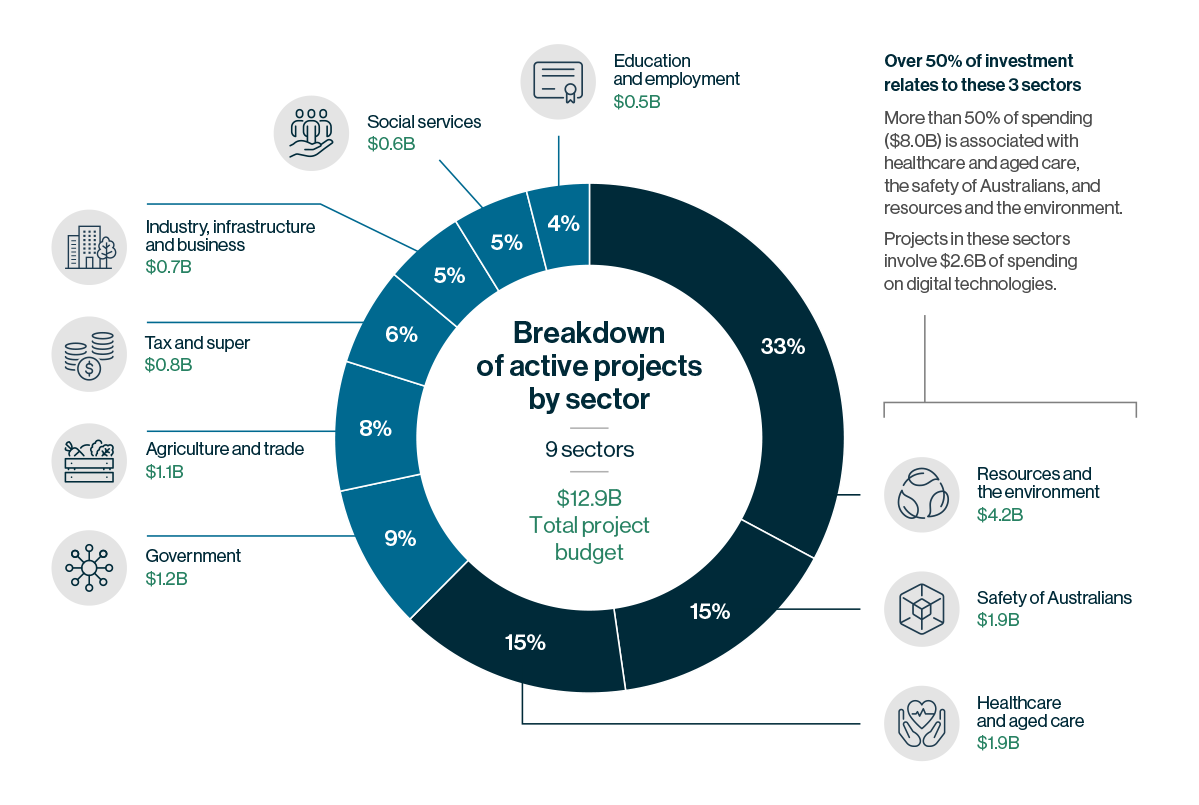
Image description
Chart header: 'Projects are delivering benefits for Australians across 9 sectors'.
The chart provides a breakdown of active projects by sector, with 9 sectors worth a total project budget of $12.9 billion.
The chart demonstrates that more than fifty percent of spending ($8.0 billion) is associated with health and aged care, the safety of Australians, and resources and the environment.
The chart further represents the breakdown of active projects by sector, according to their investment value, expressed as a percentage. Demonstrating that:
- $4.2 billion (33%) is invested in Resources and Environment
- $1.9 billion (15%) in Safety of Australians
- $1.9 billion (15%) in Health and Aged Care
- $1.2 billion (9%) in Government
- $1.1 billion (8%) in Agriculture and Trade
- $0.8 billion (6%) in Tax and Super
- $0.7 billion (5%) in Industry, Infrastructure and Business
- $0.6 billion (5%) in Social Services and
- $0.5 billion (4%) in Education and Employment.