


Figure 1 image description
Figure 1: Approach phases
The figure describes the approach phases that the assessment underwent. From assessing the build status, to evaluating what could potentially be reused, to how to implement the artifacts.
Build status
- Assessment of the completion status of each element of the Program
- Understanding of the pathway to close any residual items, or required further work
- Obtaining documentation and meeting with stakeholders
What could be reused
- Mapping the built product to the Australian Government Architecture
- Assessment of any factors potentially limiting reuse
- Determining what could be redeployed within the Australian Government
How to reuse
- Understanding the steps that another Agency would have to undertake to reuse the product
- Outlining any scope, commercial considerations, roadmap, security, team, contractual or sustainment considerations

See the missions driving the Australian Government's vision.
Figure 2 image description
Figure 2: System development lifecycle
The image shows a six-part process in a wheel, showing that stage six feeds back to stage one in a constant cycle. The six stages are:
- Plan and analyse. Define the business requirements and processes, plan the project and release management.
- Design. In the context of the client requirements, develop the architecture and blueprints and choose the technologies.
- Build. Development, coding and configuartion of the product/platform
- Test. Undertake testing to confirm the build works as expected.
- Deploy. Implement the product/platform into operational use.
- Sustain. Continue to maintain, enhance and upgrade the product/platform.
Figure 4 image description
Figure 4: GovERP current to future state
The figure describes the intended future state of uplifting an agency's enterprise resource planning from their current to future state into GovERP.
The image shows 90+ agencies with bespoke systems, shown as the 'current' state, and shows them all moving to GovERP as the 'future' state. It shows a single system for all agencies, rather than agencies each with a bespoke system.
OffGovERP was overseen by the Shared Services Sub-Committee (SSSC), comprising 13 Government entities (see Reference 2). Program delivery was a collaborative effort between the GovERP Program, Provider Hubs, and Client entities across three releases, focusing on staged delivery of an MVP in line with the P2A framework (see Reference 3).
Smaller entities were envisaged to utilise alternative technology bases such as TechnologyOne / Aurion (overseen by the Department of Industry, Science and Resources) or Oracle, and larger entities were envisaged to utilise an SAP solution overseen by Servies Australia.
The Program aimed to serve approximately 90 Commonwealth entities and around 130,000 APS staff, replacing existing ERP systems in use at five shared services hubs (see Reference 4) within:
- Department of Finance
- Australian Taxation Office
- Department of Foreign Affairs and Trade
- Department of Home Affairs
- Services Australia
The Program’s intended operating model was two corporate service ‘hubs’, specifically:
- Technology Hub: The Technology Hub was to provide infrastructure, platforms, environments, and support, and regularly update the code base and master data for use by the Provider Hubs.
- Provider Hubs: Multiple service provider hubs which were to operate independently, however, share the common code base and subset of master data, and provide services to entities.
In November 2023, the Minister for the Public Service announced a new APS ERP approach, concurrently repurposing GovERP for use by Services Australia.
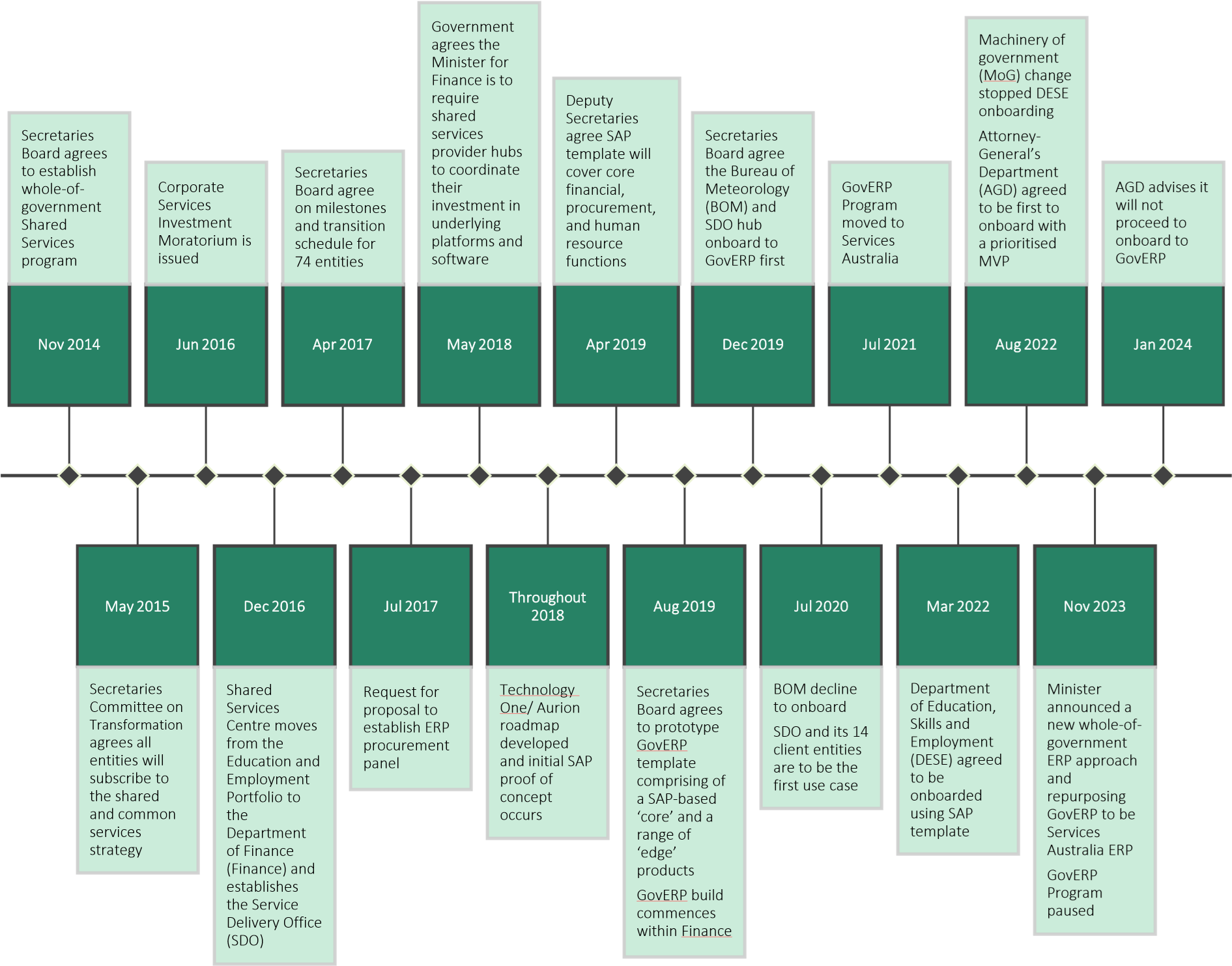
Figure 5 provides a high-level overview of the significant events in the history of GovERP. Further details can be found in Appendix I.
3.2 Solution
3.2.1 Minimum Viable Product (MVP)
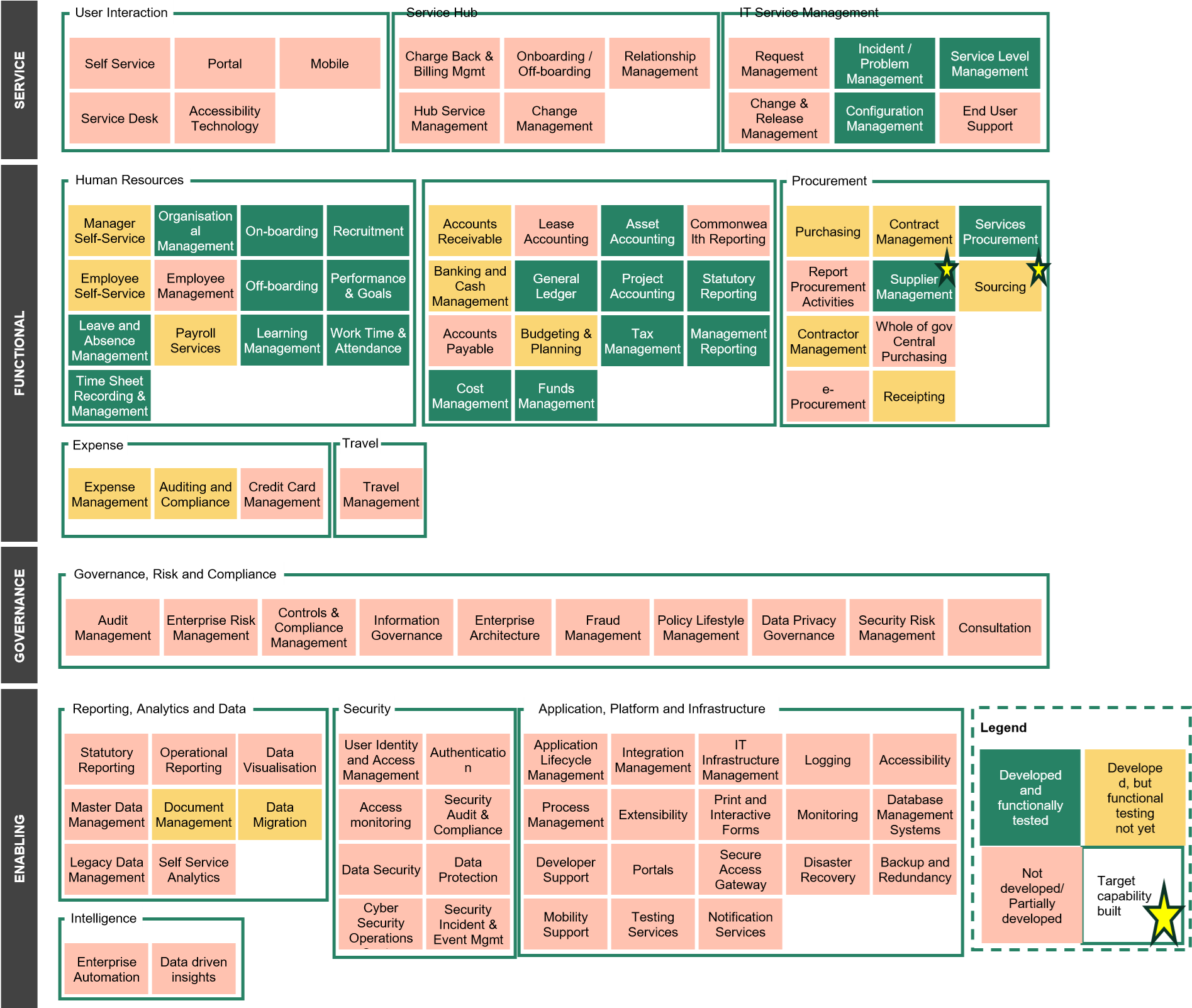
The MVP (see Reference 5) encompasses the planned capabilities for GovERP, as agreed by the Shared Services Steering Committee as outlined in Figure 6 below.
The MVP was determined based on Steering Committee Strategic Policy Decision 12
(December 2020; see Reference 6), which specified mandatory and non-mandatory capabilities. These capabilities represented what an agency would mandatorily need to deliver on; that is, the requirements that are mandated through legislation, policy, and enterprise agreements.
The salmon boxes in Figure 6 refer to those Decision 12 MVP components which were deprioritised in response changes identified during delivery of GovERP, and were not built by Services Australia. Therefore, the assessment of what has been built by Services Australia excludes these MVP salmon boxes.
Capabilities beyond the MVP were labelled as ‘target’ (or ‘extended’; see Reference 7), and were intended for future phases of the GovERP program.
Entities requiring capabilities beyond the MVP scope were required to facilitate their own integration using standard interfaces of those out-of-scope areas. This applied to both capabilities that are entirely out of scope and capabilities where a consumer chooses to use an alternate solution to that provisioned in the MVP.
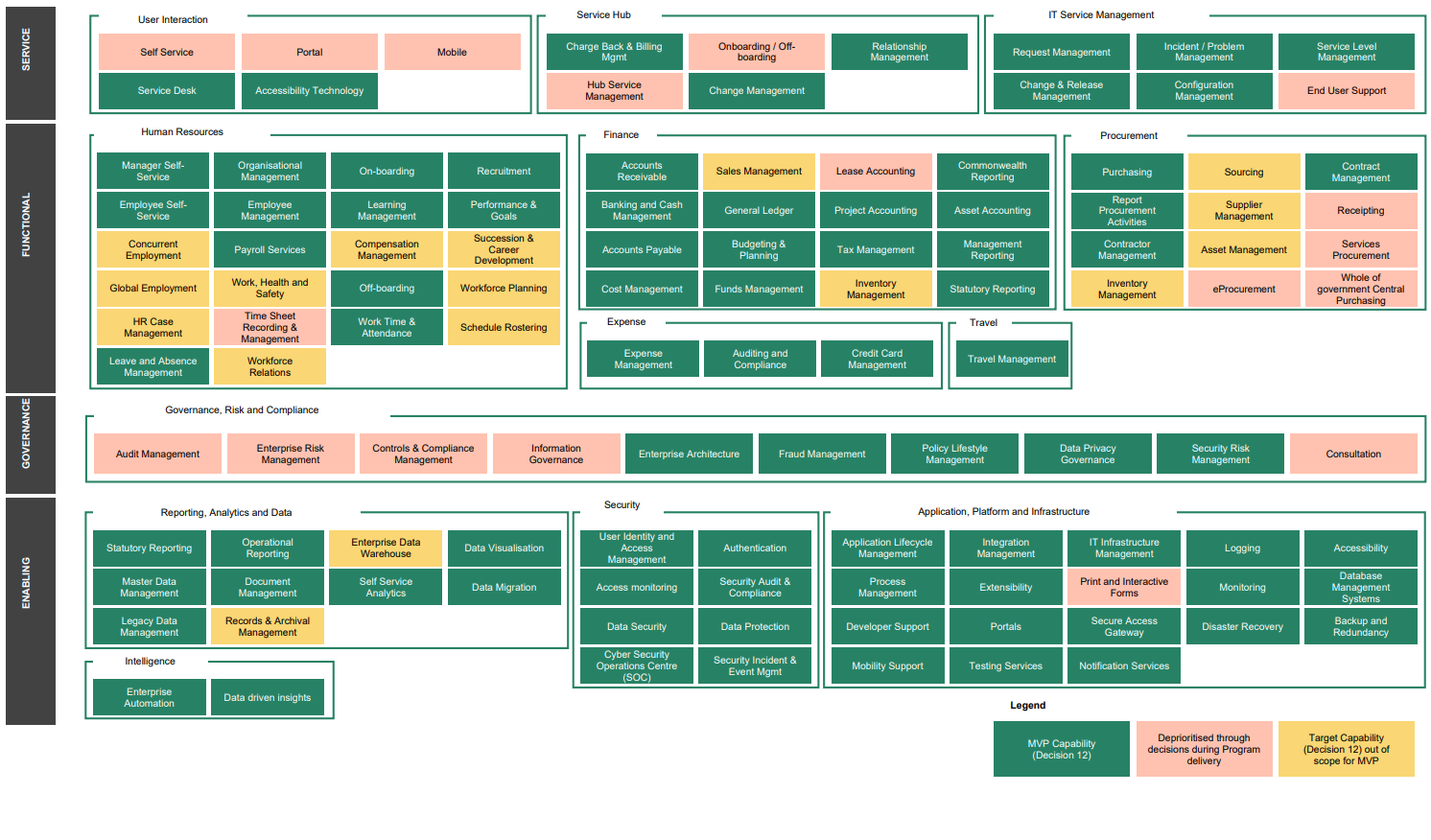
Figure 5 image description
Figure 5: High-level GovERP timeline
This figure describes the timeline of GovERP at a high level from November 2014 to January 2024.
- Nov 2014: Secretaries Board agrees to establish whole-of-government shared services program
- May 2015: Secretaries Committee on Transformation agrees all entities will subscribe to the shared and common services strategy
- Jun 2016: Corporate Services Investment Moratorium is issued
- Dec 2016: Shared Services Centre moves from the Education and Employment Portfolio to the Department of Finance (Finance) and establishes the Service Delivery Office (SDO)
- Apr 2017: Secretaries Board agree on milestones and transition schedule for 74 entities
- Jul 2017: Request for proposal to establish ERP procurement panel
- May 2018: Government agrees the Minister for Finance is to require shared services provider hubs to coordinate their investment in underlying platforms and software
- Throughout 2018: Technology One/Aurion roadmap developed and initial SAP proof of concept occurs
- Apr 2019: Deputy Secretaries agree SAP template will cover core financial, procurement, and human resource functions
- Aug 2019: Secretaries Board agrees to prototype GovERP template comprising a SAP-based 'core' and a range of 'edge' products. GovERP build commences within DoF
- Dec 2019: Secretaries Board agree the Bureau of Meteorology (BOM) and SDO hub onboard to GovERP first
- Jul 2020: BOM decline to onboard SDO and its 14 client entities are to be the first use case
- Jul 2021: GovERP Program moved to Services Australia
- Mar 2022: Department of Education, Skills and Employment (DESE) agreed to be onboarded using SAP template
- Aug 2022: Machinery of Government (MoG) change stopped DESE onboarding. Attorney-General's Department (AGD) agreed to be first to onboard with a prioritised MVP
- Nov 2023: Minister's announcement on new whole of government ERP approach and repurposing GovERP to be Services Australia GovERP/SA ERP. Program paused
- Jan 2024: AGD advises it will not proceed to onboard to GovERP/SA ERP
Figure 6 image description
Figure 6: Whole of government GovERP capability model
A complex diagram showing whole-of-government ERP capability. There are four main areas: service, functional, governance and enabling. These categories are then split into subcategories, which have a number of capabilities. These capabilities are then identified as either
- MVP capability (decision 12), which has been shortened to ‘MVP capability’
- Deprioritised through decisions during Program delivery, which has been shortened to ‘Deprioritised’, or
- Target capability (decision 12) out of scope for MVP, which has been shortened to ‘Target capability’
The contents of the diagram follow as a list. Each of the four main areas is divided into its subcategories, which then list the individual capabilities and their current status.
Service
User interaction
- Self Service – deprioritised
- Service Desk – MVP capability
- Accessibility Technology – MVP capability
- Portal – deprioritised
- Mobile – deprioritised
Service hub
- Charge Back & Billing Management – MVP capability
- Onboarding / Off-boarding – deprioritised
- Relationship Management – MVP capability
- Hub service management – deprioritised
- Change management – MVP capability
IT service management
- Request Management – MVP capability
- Incident / Problem Management – MVP capability
- Service Level Management – MVP capability
- Change & Release Management – MVP capability
- Configuration Management – MVP capability
- End User Support – deprioritised
Functional
Human Resources
- Manager Self-Service – MVP capability
- Employee Self-Service – MVP capability
- Concurrent Employment – Target capability
- Global Employment – Target capability
- HR Case Management – Target capability
- Leave and Absence Management – MVP capability
- Organisational Management – MVP capability
- Employee Management – MVP capability
- Payroll Services – MVP capability
- Work, Health and Safety – Target capability
- Time Sheet Recording & Management – Deprioritised
- Workforce Relations – Target capability
- On-boarding – MVP capability
- Learning Management – MVP capability
- Compensation Management – Target capability
- Off-boarding – MVP capability – MVP capability
- Work Time & Attendance – MVP capability
- Recruitment – MVP capability
- Performance & Goals – MVP capability
- Succession & Career Development – Target capability
- Workforce Planning – Target capability
- Schedule Rostering – Target capability
Finance
- Accounts Receivable – MVP capability
- Banking and Cash Management – MVP capability
- Accounts Payable – MVP capability
- Cost Management – MVP capability
- Sales management – Target capability
- General Ledger – MVP capability
- Budgeting & Planning – MVP capability
- Funds Management – MVP capability
- Lease accounting – deprioritised
- Project accounting – MVP capability
- Tax management – MVP capability
- Inventory management – Target capability
- Commonwealth reporting – MVP capability
- Asset accounting – MVP capability
- Management reporting – MVP capability
- Statutory reporting - MVP capability
Expense
- Expense Management – MVP capability
- Auditing and Compliance – MVP capability
- Credit Card Management – MVP capability
Travel
- Travel Management – MVP capability
Procurement
- Purchasing – MVP capability
- Sourcing – MVP capability
- Contractor Management – MVP capability
- Inventory Management – Target capability
- Sourcing – Target capability
- Supplier Management – Target capability
- Asset management – Target capability
- eProcurement – deprioritised
- Contract management – MVP capability
- Receipting – deprioritised
- Services procurement – deprioritised
- Whole-of-government central purchasing – deprioritised
Governance
Governance, Risk and Compliance
- Audit Management – deprioritised
- Enterprise Risk Management – deprioritised
- Controls & Compliance Management – deprioritised
- Information Governance – deprioritised
- Enterprise Architecture – MVP capability
- Fraud Management – MVP capability
- Policy Lifecycle Management – MVP capability
- Data Privacy Governance – MVP capability
- Security Risk Management – MVP capability
- Consultation – deprioritised
Enabling
Reporting, Analytics and Data
- Statutory Reporting – MVP capability
- Operational Reporting – MVP capability
- Enterprise Data Warehouse – Target capability
- Data Visualisation – MVP capability
- Master Data Management – MVP capability
- Document Management – MVP capability
- Self Service Analytics – MVP capability
- Data Migration – MVP capability
- Legacy Data Management – MVP capability
- Records & Archival Management – Target capability
Security
- User Identity and Access Management – MVP capability
- Authentication – MVP capability
- Access monitoring – MVP capability
- Security Audit & Compliance – MVP capability
- Data Security – MVP capability
- Data Protection – MVP capability
- Cyber Security Operations Centre (SOC) – MVP capability
- Security Incident & Event Management – MVP capability
Application, Platform and Infrastructure
- Application Lifecycle Management – MVP capability
- Integration Management – MVP capability
- IT Infrastructure Management – MVP capability
- Logging – MVP capability
- Accessibility – MVP capability
- Process Management – MVP capability
- Extensibility – MVP capability
- Print and Interactive Forms – deprioritised
- Monitoring – MVP capability
- Database Management Systems – MVP capability
- Developer Support – MVP capability
- Portals – MVP capability
- Secure Access Gateway – MVP capability
- Disaster Recovery – MVP capability
- Backup and Redundancy – MVP capability
- Mobility Support – MVP capability
- Testing Services – MVP capability
- Notification Services – MVP capability
Intelligence
- Enterprise Automation – MVP capability
- Data driven Insights – MVP capability
3.2.2 Value streams
To support the future one-APS vision, it was important to consolidate and standardise disparate corporate processes within the Australian government. The GovERP value streams comprise:
- Hire to Retire (H2R): This value stream manages the entire human resource lifecycle within the APS. It encompasses recruitment, onboarding, mobility, pay, performance management, workforce management, and separations.
- Budget to Report (B2R): This value stream covers the financial management lifecycle of an agency, from external budgeting to the release of financial statements. It includes external budgeting, internal budgeting, sub ledger aggregation, consolidation, adjustment, closure, and reporting.
- Revenue to Bank (R2B): This value stream oversees the revenue lifecycle of an agency, from revenue generation to Banking and Treasury functions. It includes proposing funding and charging arrangements, formalising agreements, delivering services, invoicing, banking, managing outstanding items, and reporting.
- Procure to Pay (P2P): This value stream manages the purchasing and contract lifecycle for acquiring goods and services to support an entity’s business. It includes sourcing, requisition, order processing, payments, and reporting.
- Travel and Expense (TEMS): This value stream handles the lifecycle of reporting issues or lodging requests, from triage to resolution or fulfilment. It also includes supporting materials such as knowledge base articles or help cards to assist users in resolving their own issues.
- Enquire to Resolve (E2R): This value stream manages the support lifecycle of reporting issues or lodging requests, from triage to resolution or fulfilment. It’s important to note that this value stream falls outside the scope of this report.
- Prepare to Adopt (P2A): This value stream manages the lifecycle of change management that guides individuals, groups, and organisations through transitions. While its primary focus lies in facilitating entities’ onboarding into GovERP, it also serves ongoing functions. During onboarding, this value stream supports seven project phases, ensuring readiness to transition, initial engagement and discovery, preparation and planning, design, documentation, building, training, and testing, monitoring and stabilising, and continuous improvement. In its ongoing capacity, P2A aids in assessing planned change, consulting stakeholders, preparing communication/training materials, implementing change, and managing change (see Reference 9). It’s important to note that this value stream falls outside the scope of this report.
Service and functional capabilities within the business capability model have been mapped to value streams in Figure 7 below. These highlighted capabilities represent most of the functionality for each value stream, although not necessarily all capabilities involved.
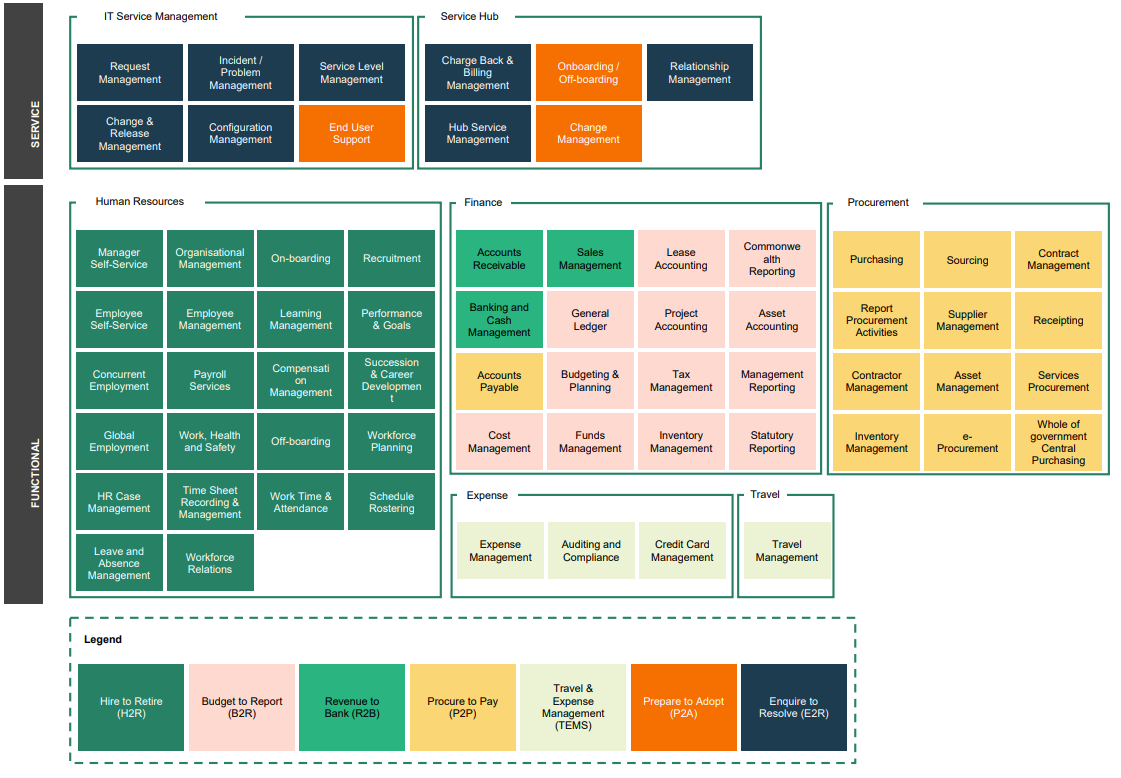
Figure 7 image description
Figure 7: Value stream mapping
The graphic shows capabilities, grouped by type business area, and which value stream they are in. The following list is ordered by type, then business area, then capability type.
Service
IT service management
- Enquire to resolve (E2R)
- Request management
- Change and release management
- Incident/problem management
- Configuration management
- Service level management
- End user support
- Prepare to adopt (P2A)
- End user support
Service Hub
- Enquire to resolve (E2R)
- Charge back and billing management
- Hub service management
- relationship management
- Prepare to adopt (P2A)
- onboarding/offboarding
- change management
Functional
Human resources
- Hire to retire (H2R)
- manager self-service
- employee self-service
- concurrent employment
- leave and absence management
- organisational management
- employee management
- payroll services
- time sheet recording and management
- on-boarding
- off-boarding
- work time and attendance
- HR case management
- work, health and safety
- workforce relations
- learning management
- compensation management
- recruitment
- performance and goals
- succession and career development
- workforce planning
- schedule rostering
Finance
- Revenue to Bank (R2B)
- accounts receivable
- banking and cash management
- sales management
- Procure to Pay (P2P)
- accounts payable
- Budget to Report (B2R)
- cost management
- general ledger
- budgeting and planning
- funds management
- lease accounting
- project accounting
- tax management
- inventory management
- Commonwealth reporting
- asset accounting
- management reporting
- statutory reporting
Expense
- Travel and expense management (TEMS)
- expense management
- auditing and compliance
- credit card management
Travel
- Travel and expense management (TEMS)
- Travel management
Procurement
- Procure to Pay (P2P)
- purchasing
- report procurement activities
- inventory management
- supplier management
- asset management
- receipting
- services procurement
- whole of government central purchasing
- contractor management
- sourcing
- e-procurement
- contract management
Entities are expected to access services through value streams, which delineate the scope of offerings. While five value streams support functional capabilities, two of them (Prepare to Adopt and Enquire to Resolve; see Reference 10) are pivotal for the service management and the on-boarding of client entities and Provider hubs.
Value streams transcend capabilities and functions, and entities within shared services, integrating these elements to deliver value to stakeholders.
Rather than representing discrete services, value streams embody overarching lifecycles in which all entities participate to achieve business outcomes.
Each value stream encompasses a series of customer journeys and associated processes.
The MVP was designed as a foundational template encompassing essential solutions necessary for supporting critical government functions. These solutions included robust capabilities in human resources, finance, procurement, and travel and expense management, forming the core framework of the ERP system designed to meet specific APS requirements.
Additionally, it embraced additional edge functionalities like recruitment, onboarding, learning management, success planning, and performance measurement, enhancing the versatility and utility of the ERP solution.
Core and edge capabilities were categorised as:
- core capabilities: These are fundamental building blocks required to deliver a basic ERP solution.
- edge capabilities: All other capabilities beyond core functionalities.
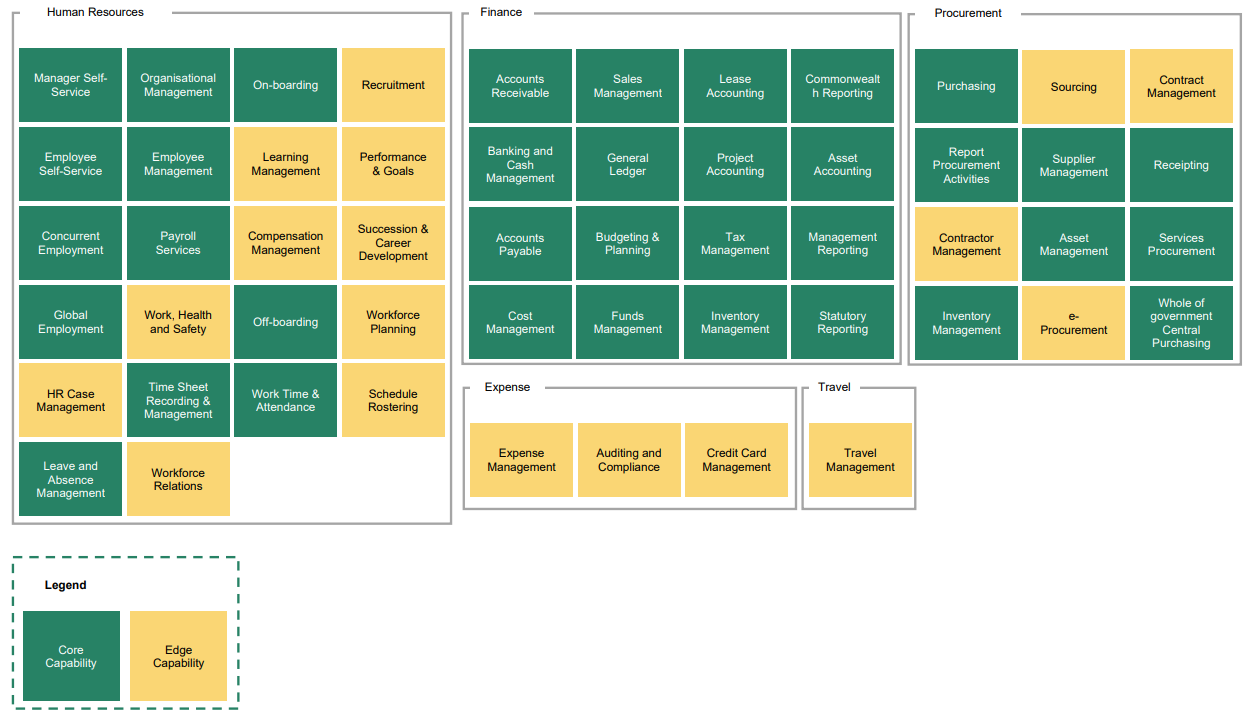
The Core implementation was standardised; however, entities had flexibility to choose Edge products according to their specific needs. A panel of products and partners was established, offering a range of options for Edge products.
GovERP adopted an incremental delivery approach for both core and edge capabilities, aligning with a whole of government solution template.
3.3 Technical architecture
GovERP’s core offerings comprised SAP S/4HANA and SAP SuccessFactors, with various other capabilities operating as ‘Edge’ systems extending the core. Provider Hubs used this template to create an instance of the GovERP system to support their client entities.
External and internal traffic was expected to pass through an outsourced Secure Internet Gateway (SIG), with all GovERP SaaS applications hosted on secure clouds in Australian data centres. Note, a vendor was procured for the SIG, but the contract was not executed given the pause of the GovERP Program.
References
- GovERP End to End Solution Architecture v2.0
- Entities represented on the SSSC included: Department of Finance; Australian Taxation Office; Department of Foreign Affairs and Trade; Digital Transformation Agency; Bureau of Meteorology; Services Australia; Department of Health; Department of Agriculture, Water and the Environment; Department of Education, Skills and Employment; Department of Industry, Science, Energy and Resources; Australian Financial Security Authority; Department of Social Services; and the Department of Home Affairs
- Per Decision 22 of the Decision Framework Briefing_Outcomes of SSSC, page 145
- Per Decision 7 of the Decision Framework Briefing_Outcomes of SSSC, page 47
- Per Decision 12 of the Decision Framework Briefing_Outcomes of SSSC, page 91.
- Per Decision 12 of the Decision Framework Briefing_Outcomes of SSSC, page 91.
- Extended capabilities represented functions that are used and required across many entities, but not necessarily all.
- During delivery of GovERP, within the Human Resources business area, “Work Time and Attendance” and “Time Sheet Recording and Management” were combined into a single set of processes within SAP Signavio. From there, a single capability, “Work and Time Attendance” was reported on at a capability level.
- Note, the above does not include vendors or solutions for Secure Internet Gateway or Centralised Identity Provider, as procurement activities were not finalised.
- These two value streams (Prepare to Adopt and Enquire to Resolve) are out of scope of this assessment
Figure 8 image description
Figure 8: Core and edge capabilities
The graphic shows core and edge capabilities, grouped by business area, and whether they are core capabilities or edge capabilities. The following list is ordered by business area, then whether capabilities are core or edge capabilities.
Human resources
- Core capabilities
- manager self-service
- employee self-service
- concurrent employment
- global employment
- leave and absence management
- organisational management
- employee management
- payroll services
- time sheet recording and management
- on-boarding
- off-boarding
- work time and attendance
- Edge capabilities
- HR case management
- work, health and safety
- workforce relations
- learning management
- compensation management
- recruitment
- performance and goals
- succession and career development
- workforce planning
- schedule rostering
Finance – all core capabilities
- accounts receivable
- banking and cash management
- accounts payable
- cost management
- sales management
- general ledger
- budgeting and planning
- funds management
- lease accounting
- project accounting
- tax management
- inventory management
- Commonwealth reporting
- asset accounting
- management reporting
- statutory reporting
Expense – all edge capabilities
- expense management
- auditing and compliance
- credit card management
Travel
- Travel management (edge capability)
Procurement
- Core capabilities
- purchasing
- report procurement activities
- inventory management
- supplier management
- asset management
- receipting
- services procurement
- whole of government central purchasing
- Edge capabilities
- contractor management
- sourcing
- e-procurement
- contract management
Figure 9 image description
Figure 9: Value stream build completeness
The table above contains the following information:
1. Hire to retire
Developed and functionally tested
• Learning management
• Leave and absence management
• Organisational management
• Performance and goals management
• Recruitment
• On-boarding
• Off-boarding
• Work time and attendance
• Time sheet recording and management
Developed, but functional testing not yet passed
• Manager self-service
• Employ self-service
• Payroll services
2. Budget to report
Developed and functionally tested
• Asset accounting
• Cost management
• Funds management
• General ledger
• Project accounting
• Tax management
• Statutory reporting
• Management reporting
Developed, but functional testing not yet passed
• Budgeting and planning
3. Revenue to bank
Developed, but functional testing not yet passed
• Accounts receivable
• Banking and cash management
4. Procure to pay
Developed and functionally tested
• Services procurement
Developed, but functional testing not yet passed
• Purchasing
• Receipting
• Contractor management
• Contract management
4a. Target capability built in procure to pay
Developed and functionally tested
• Supplier management
Developed, but functional testing not yet passed
- Sourcing
5. Travel & expense
Developed, but functional testing not yet passed
• Expense management
• Auditing and compliance

You can download a full-colour PDF of the Strategy and Implementation Plan.
Note, no System Integration Testing (SIT) or User Acceptance Testing (UAT) occurred as part of GovERP.
The table below summarises the current capability status within the value streams.
| Value stream | Full GovERP Solution coverage | MVP1.1 solution coverage | ||
|---|---|---|---|---|
Built | Planned | Built | Planned | |
| Hire to Retire (H2R) | 9 | 22 | 9 | 13 |
| Finance, including Revenue to Bank (R2B) and Budget to Report (B2R) | 8 | 15 | 8 | 13 |
| Procure-to-pay (P2P) | 2 | 13 | 1 (see Table note 1) | 9 |
| Travel and expense management (TEMS) | 0 | 4 | 0 (see Table note 2) | 4 |
| Total | 19 | 54 | 18 | 39 |
Table note 1: “Supplier Management” was not in scope of MVP1.1. However, Services Australia built and functionally tested this capability.
Table note 2: The vendor, 8common, advised all build elements were completed and tested, however, these were not integrated by Services Australia as part of the GovERP solution.
In respect of the above value streams, a total of 167 WRICEFs were identified as part of this assessment, of which 13 relate to AGD.
4.2 Functions and capability
Further to the Value Stream view provided in Section 4.1, below is the current build completeness of each capability within GovERP.
The status provided aligns with the information communicated by Services Australia (see Reference 1). Appendix C provides details on the intended contents of each component box.
Engagement with stakeholders identified the need for enhancements to meet the specific requirements of other entities. Anecdotally, this was always expected within the GovERP intended operating model, prior to project’s pause. For example, additional changes to MVP1.1 with AGD enhancements were identified to address the needs and scenarios of AGD, particularly in areas such as recruitment, learning management, finance and procurement.
Further insights into the build status of each of the Value Streams is discussed in the subsequent sections.