Maile is Group Executive Australia Retail, ANZ’s largest business which serves around five million retail customers through an extensive network of branches, ATMs and leading online and mobile banking applications and digital solutions. Since joining ANZ, she has been developing enterprise-wide digital capability, including
the transformation of the Australia Business which aims to improve the financial wellbeing of ANZ customers. Maile also holds Group accountability for design and marketing which includes ANZ’s brand, advertising and sponsorships. She is a Non-Executive Director on the Board of ANZ Bank New Zealand Limited.
Maile is keenly focused on customer centric innovation and design. She joined ANZ in 2016 from Google where she was Managing Director Australia and New Zealand. She also spent over 20 years with Proctor and Gamble in roles including Managing Director Australia and New Zealand, General Manager for Asia Strategy, Marketing and Design based in Singapore and a number of senior commercial roles in the United States.
With a passion for helping future generations, Maile contributed as one of six members on the independent review of the Australian Public Service, was previously Vice-Chair of the ASIC External Advisory Panel and a board member of Innovation and Science Australia. She is currently a member of the Board at University of Technology, Sydney and a Trustee of the Australian Museum.
Maile holds a degree in Business Administration in Finance, Economics and Marketing from the University of Technology Sydney.
Ms Catherine D’Elia
Catherine is a senior executive with an excellent track record in leading people centred, innovative, strategic, service-oriented solutions, leveraging technology, transforming culture and streamlining processes across geographies.
With a strong background in strategic leadership, large scale change management, executive level collaboration, Catherine has a proven track record in fostering a positive work environment, complex problem resolution, and internal and external relationship management.
Catherine has held senior positions in the NSW public service for the last 16 years, including as a Deputy Secretary in the Department of Communities and Justice Department. Prior to joining the public service, Catherine held senior positions in the banking sector at NAB and Citizens Bank in the US.
Catherine holds a Masters in Education, Human Resource Development from Boston University, as well as a Bachelor of Arts in International Relations from the University of New Hampshire.
Mr Chris Cawood
Chris has over 30 years’ leadership and technical experience across heavy industry sectors including manufacturing, oil and gas, mining and transport.
Chris joined Ixom in late 2021 and was previously the Chief
Information Officer of OceanaGold for eight years. Prior to this he had an extensive career with BHP, where he held CIO roles in various business units.
Chris developed a passion for technology transformation and change in his early career in the BHP Steel (now BlueScope) marketing team. From there, he progressed into leadership roles with the BHP Petroleum division in Western Australia and for five years was involved in the expansion of its oil and gas assets. He was appointed to CIO roles in the coal and marketing divisions of BHP and was responsible for large technology transformation projects as well as a number of M&A integrations and divestments.
Chris has significant experience working in multicultural environments and with diverse teams. He has lived in Europe and worked closely with colleagues and external stakeholders in Pakistan, Japan, China, Africa, Singapore, The Philippines and North America.
Chris holds a Bachelor of Science and Education degree from Melbourne University.
Mr Chris Fechner
Chris Fechner was appointed the Chief Executive Officer at the Digital Transformation Agency on 13 October 2021.
Chris is also the Head of the Digital Profession; he started his two-year term in January 2023.
Chris has extensive experience in state government
services, focusing on large scale digital and ICT reform and transformation programs as well as implementing contemporary investment, contestability, and governance frameworks.
Before joining the Australian Public Service, Chris was the Queensland Government Chief
Customer and Digital Officer throughout 2020 and 2021. Chris was previously the Chief Digital and Product Officer at Service NSW. Prior to that, Chris held a number of senior positions across the NSW and Queensland governments as well as in freight and rail organisations.
Chris holds an Executive Masters of Business Administration and a Bachelor of Applied Science and Computing, both from the Queensland University of Technology.
As CEO, Chris is responsible for leading the agency to ensure we deliver on the government’s digital transformation agenda, in accordance with our agency’s executive order and the Public Governance, Performance and Accountability Act 2013.
Appendix C: Technical assessment report
Appendix C:Technical assessment report
Appendix C can be found on digital.gov.au together with this Eminent Panel report.
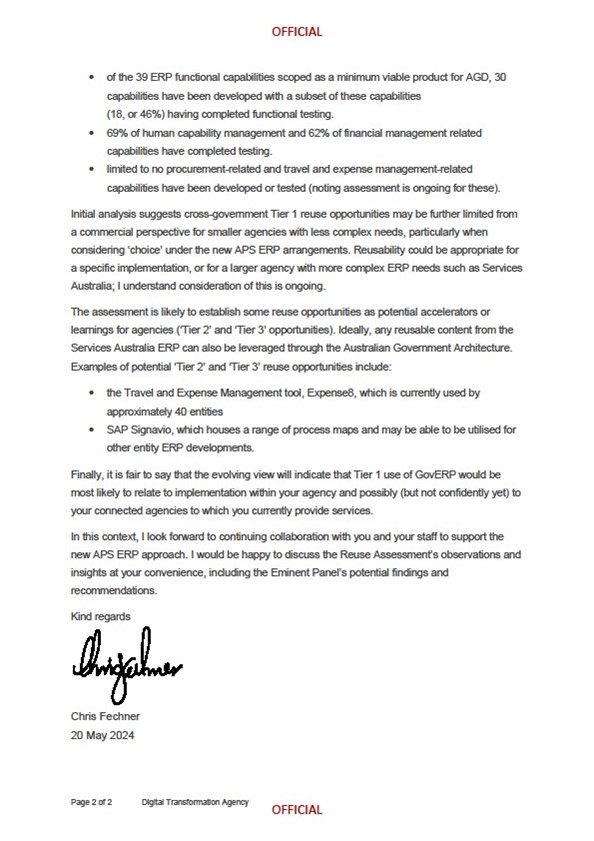
Correspondence from DTA CEO to Services Australia CEO, 20 May 2024 sharing preliminary observations and insights of the Assessment
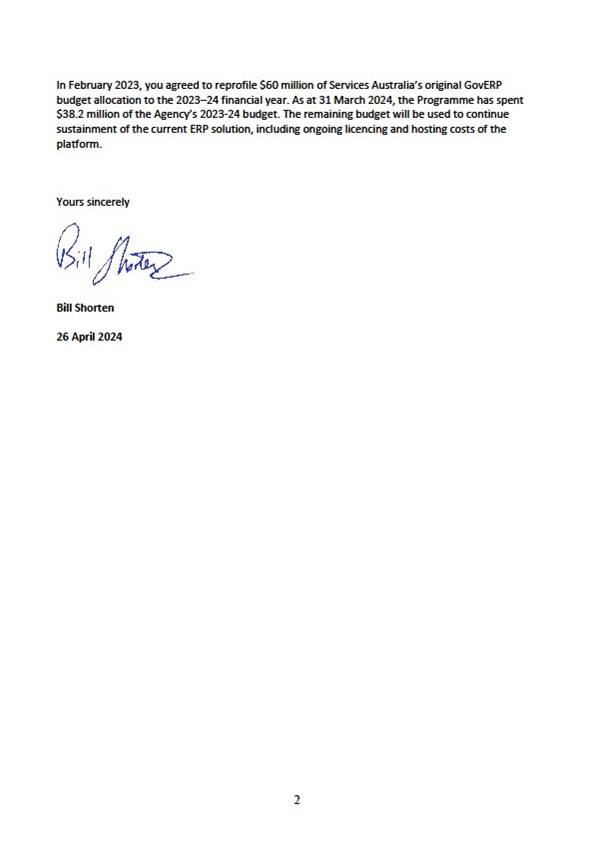
Correspondence from the Minister for Government Services to the Minister for Finance, 26 April 2024 providing an update on the GovERP program
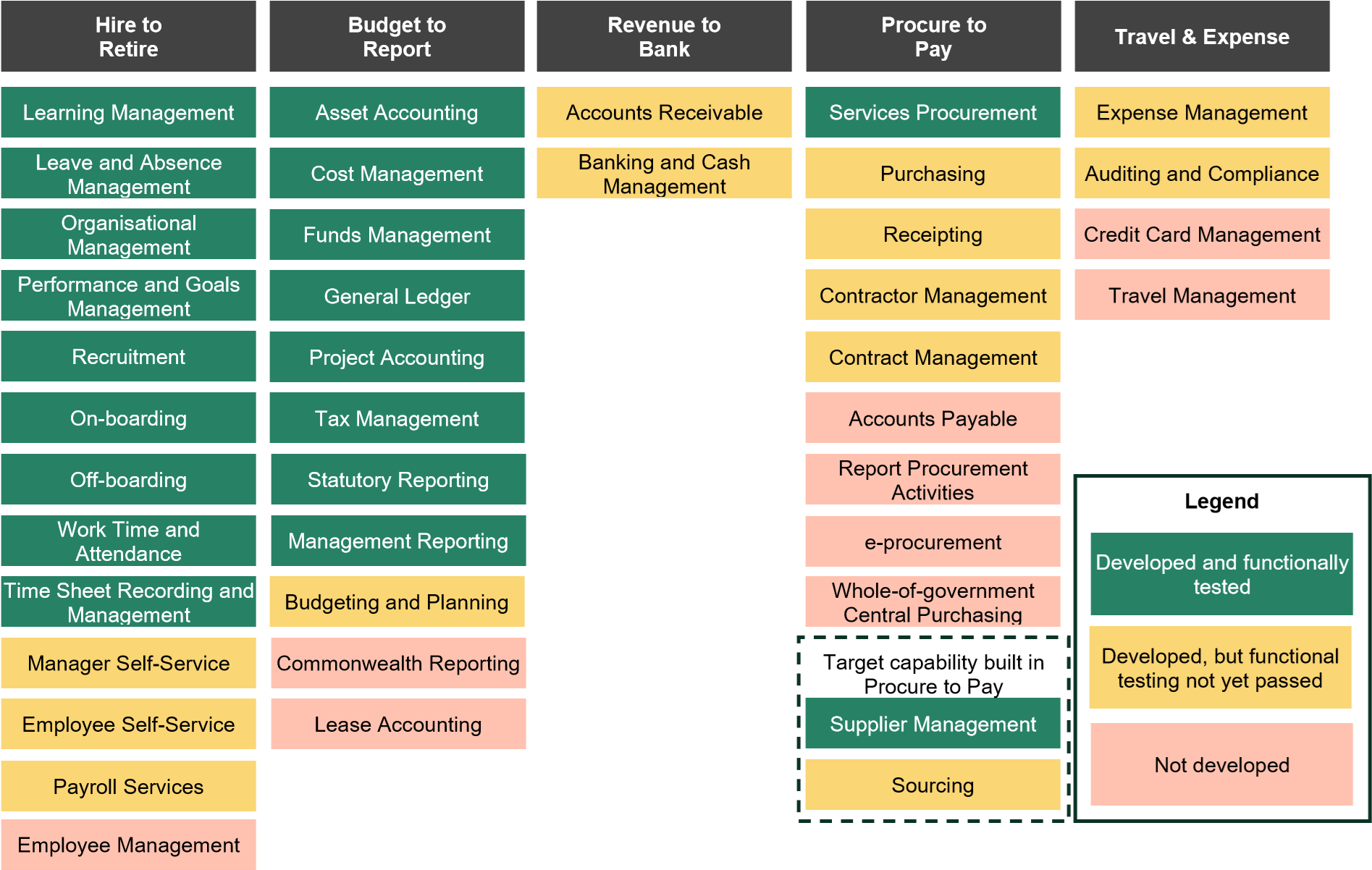
Appendix F: MVP capabilities for GovERP (Image version)
Appendix F:MVP capabilities for GovERP
Shared Services Steering Committee-agreed MVP 1.0 capabilities for whole-of-government purposes
The above table is a list of capabilities grouped by value stream.
Within this set of capabilities, a scope for initial delivery (MVP) and target state were both defined, as reflected in the blue and purple respectively. Capabilities marked with a star are those Extended Capabilities that were to be considered for inclusion in the scope of Shared Services.
A brief description of each of the MVP1.1 functional capabilities is below.
Capability
Description
Hire to Retire (H2R)
Learning management
This capability relates to administration, documentation, tracking, reporting, and delivery of educational courses, training programs, or learning and development initiatives within an entity
Leave and absence management
Processes and systems used by an entity to manage employee time off, including vacation, sick leave, and other types of absences
Organisational management
Process of planning, coordinating, and overseeing the various functions and operations within an entity
Performance and goals management
Setting, tracking, and evaluating employee performance against established goals and objectives
Recruitment
Process of identifying and attracting candidates to fill job vacancies within the entity including the entire hiring process, from inception to the individual recruit's integration into the entity
On-boarding
Integration of new employees into an entity
Off-boarding
The process of managing the departure of an employee from an entity
Work time and attendance
Systems used by entities of all sizes, across the APS, to ensure accuracy of employee's time and attendance, pay and absence requests
Time sheet recording and management
Tracking and managing employee work hours and attendance
Capability
Description
Manager self service
Enables managers to access personnel data for their direct reports, such as leave, time-off, performance, and learning information.
Employee self service
System that supports employees to access and manage their own personal and employment-related information
Payroll services
Administration of an entity's employee's financial records including salaries, wages, bonuses, deductions, and net pay
Employee management
Processes, systems, and practices used by an entity to manage its workforce
Budget to Report (B2R)
Asset accounting
Sub-ledger that records the financial transactions related to an entities’ assets
Cost management
Planning, estimating, budgeting, and controlling costs in a project or business operation
Funds management
Managing and overseeing the financial resources of an entity
General ledger
Complete record of all financial transactions over the life of an entity
Project accounting
Financial transactions related to managing a project including costs, billing, and revenue
Tax management
Management of an entity’s tax obligations to ensure Australian tax laws and regulations compliance
Statutory reporting
The mandatory submission of financial and non-financial information by an entity to the australian government or regulatory bodies
Management
reporting
Provision of information to managers, to assist with informed decisions including tracking progress or KPI’s, identifying trends, and highlighting areas that may require attention or improvement
Budgeting and planning
The process of creating a detailed financial plan for an entities’ future expenses and revenues
Commonwealth
reporting
Mandatory reporting requirements for Australian Government entities to prepare and submit financial statements, performance reports, and other information to the government in accordance with relevant legislation and accounting standards
Lease accounting
The accounting treatment of leases, which are contractual agreements between a lessee and a lessor for the use of an asset
Revenue to Bank (R2B)
Accounts receivable
Funds that customers owe for products or services that have been invoiced
Banking and cash management
The operational and banking processes associated with the collection, aggregation, holding and disbursement of cash
Procure to Pay (P2)
Service procurement
The process of acquiring services from vendors including preparing RFTs/RFQs, managing purchasing and contract lifecycles, sourcing, requisition, order processing, payments and reporting
Purchasing
Purchase of goods and/or services by an entity
Capability
Description
Receipting
The process of recording and acknowledging the receipt of goods, services, or payments
Contractor management
Management of the relationship between an entity and its contractors
Contract management
Process of managing legally binding agreements including creation and negotiation, contract execution, contract compliance monitoring and renewal or close out
Accounts payable
Money owed by the entity to its vendors
Report procurement
activities
Reports showing procurement activities, costings and purchasing information regarding goods and/or services
e-Procurement
Use of electronic methods to conduct transactions between buyers and suppliers
Whole-ofgovernment central purchasing
Whole-of-government procurement designed for permission-based services as permits, accreditations, licenses, and registrations
Supplier
management
Task ensuring suppliers meet the expectations of their contract
Sourcing
Process of locating products or services outside the entity
Travel and Expense Management (TEMs)
Expense management
Bookkeeping system for controlling, tracking, and processing employee expense reimbursements
Auditing and compliance management
Measurement of an entity’s adherence to rules and regulations, standards, and any relevant internal bylaws and codes of conduct
System used by entities to oversee and facilitate business travel
Off
Appendix F:MVP capabilities for GovERP
Shared Services Steering Committee-agreed MVP 1.0 capabilities for whole-of-government purposes
The above table is a list of capabilities grouped by value stream.
Within this set of capabilities, a scope for initial delivery (MVP) and target state were both defined, as reflected in the blue and purple respectively. Capabilities marked with a star are those Extended Capabilities that were to be considered for inclusion in the scope of Shared Services.
A brief description of each of the MVP1.1 functional capabilities is below.
Capability
Description
Hire to Retire (H2R)
Learning management
This capability relates to administration, documentation, tracking, reporting, and delivery of educational courses, training programs, or learning and development initiatives within an entity
Leave and absence management
Processes and systems used by an entity to manage employee time off, including vacation, sick leave, and other types of absences
Organisational management
Process of planning, coordinating, and overseeing the various functions and operations within an entity
Performance and goals management
Setting, tracking, and evaluating employee performance against established goals and objectives
Recruitment
Process of identifying and attracting candidates to fill job vacancies within the entity including the entire hiring process, from inception to the individual recruit's integration into the entity
On-boarding
Integration of new employees into an entity
Off-boarding
The process of managing the departure of an employee from an entity
Work time and attendance
Systems used by entities of all sizes, across the APS, to ensure accuracy of employee's time and attendance, pay and absence requests
Time sheet recording and management
Tracking and managing employee work hours and attendance
Capability
Description
Manager self service
Enables managers to access personnel data for their direct reports, such as leave, time-off, performance, and learning information.
Employee self service
System that supports employees to access and manage their own personal and employment-related information
Payroll services
Administration of an entity's employee's financial records including salaries, wages, bonuses, deductions, and net pay
Employee management
Processes, systems, and practices used by an entity to manage its workforce
Budget to Report (B2R)
Asset accounting
Sub-ledger that records the financial transactions related to an entities’ assets
Cost management
Planning, estimating, budgeting, and controlling costs in a project or business operation
Funds management
Managing and overseeing the financial resources of an entity
General ledger
Complete record of all financial transactions over the life of an entity
Project accounting
Financial transactions related to managing a project including costs, billing, and revenue
Tax management
Management of an entity’s tax obligations to ensure Australian tax laws and regulations compliance
Statutory reporting
The mandatory submission of financial and non-financial information by an entity to the australian government or regulatory bodies
Management
reporting
Provision of information to managers, to assist with informed decisions including tracking progress or KPI’s, identifying trends, and highlighting areas that may require attention or improvement
Budgeting and planning
The process of creating a detailed financial plan for an entities’ future expenses and revenues
Commonwealth
reporting
Mandatory reporting requirements for Australian Government entities to prepare and submit financial statements, performance reports, and other information to the government in accordance with relevant legislation and accounting standards
Lease accounting
The accounting treatment of leases, which are contractual agreements between a lessee and a lessor for the use of an asset
Revenue to Bank (R2B)
Accounts receivable
Funds that customers owe for products or services that have been invoiced
Banking and cash management
The operational and banking processes associated with the collection, aggregation, holding and disbursement of cash
Procure to Pay (P2)
Service procurement
The process of acquiring services from vendors including preparing RFTs/RFQs, managing purchasing and contract lifecycles, sourcing, requisition, order processing, payments and reporting
Purchasing
Purchase of goods and/or services by an entity
Capability
Description
Receipting
The process of recording and acknowledging the receipt of goods, services, or payments
Contractor management
Management of the relationship between an entity and its contractors
Contract management
Process of managing legally binding agreements including creation and negotiation, contract execution, contract compliance monitoring and renewal or close out
Accounts payable
Money owed by the entity to its vendors
Report procurement
activities
Reports showing procurement activities, costings and purchasing information regarding goods and/or services
e-Procurement
Use of electronic methods to conduct transactions between buyers and suppliers
Whole-ofgovernment central purchasing
Whole-of-government procurement designed for permission-based services as permits, accreditations, licenses, and registrations
Supplier
management
Task ensuring suppliers meet the expectations of their contract
Sourcing
Process of locating products or services outside the entity
Travel and Expense Management (TEMs)
Expense management
Bookkeeping system for controlling, tracking, and processing employee expense reimbursements
Auditing and compliance management
Measurement of an entity’s adherence to rules and regulations, standards, and any relevant internal bylaws and codes of conduct
System used by entities to oversee and facilitate business travel
2. Introduction
2.1 Purpose
This Reuse Assessment Review report is an independent assessment of the Australian Government ERP ecosystem, GovERP.
Taking into account what has been built as part of MVP 1.1 in preparing to onboard the Attorney-General’s Department (AGD) and the full scope of the ERP requirements of Commonwealth entities (MVP1.0), the assessment provides evidence upon which to assess the reuse potential of the GovERP solution and the ability to implement the Hire to Retire (H2R), Budget to Report (B2R), Revenue to Bank (R2B), Procure-to-Pay (P2P) and Travel and Expense Management (TEMS) value streams.
The report provides:
an assessment of the completeness and maturity of the GovERP system. Where Services Australia GovERP development is incomplete or ongoing, an assessment of what capabilities are outstanding and the schedule for their delivery.
consideration of the feasibility of incomplete parts to provide an understanding of how long it would take other Commonwealth entities to use the capability.
capabilities, functions and/or modules that meet the reuse principles and why.
capabilities, functions and/or modules that do not meet reuse principles and why.
expert insights that assist the DTA to provide recommendations to improve the reuse potential of the capabilities, functions and/or modules that do not meet the reuse requirements.
2.2 Scope
2.2.1 In scope
This report includes the following:
a catalogue of business functions that the GovERP provides, and a mapping of alignment between these capabilities and the underlying and supporting IT infrastructure (software and hardware), including any modules or extensions with GovERP.
GovERP solution’s value streams, Hire to Retire, Revenue to Bank, Budget to Report, Procure to Pay, and Travel and Expense Management.
functional diagrams, at the application and infrastructure levels, of the GovERP system.
evaluation of environments, systems, processes, GovERP configuration, design data, and IT architecture artefacts (e.g. business catalogues, interfaces, APIs, and SAP core function customisations).
all components of the GovERP system, including Application Programming Interfaces (APIs) and other connection points with external systems.
implementation considerations for other entities when exploring GovERP’s potential reuse.
evaluating the build and implementation status of GovERP, including readiness for reusing existing environments, systems, processes, and data (standards and integration).
identifying elements of GovERP that could potentially be reused, including any limitations which may be applicable.
outlining how other Australian Government entities can reuse GovERP for their needs.
offering insights into GovERP’s reuse potential and specific implementation pathways for other Australian Government entities.
2.2.2 Out of scope
This report does not cover:
assessment of GovERP’s scope or the validity of the original business case, or other elements of the GovERP Program beyond the technology focus of this report e.g. appropriateness of the scope of the MVP.
analysis of the program’s performance or factors leading to the GovERP Program’s pause.
the following value streams:
Prepare to Adopt (P2A) as this relates only to change management and the implementation of GovERP, and as such no technologies were designed or built which could be considered for reuse.
Enquire to Resolve (E2R), as this is focused on IT Service Management, rather than a functional build of the ERP solution.
comparison of existing entity business processes with those in GovERP.
mapping of GovERP architecture to existing entity architecture.
detailed costings related to implementation, as these depend on agency-specific factors (e.g. the approach to be taken, the maturity of the capability and the existing workforce capabilities).
consideration of any customisation / configuration or data migration requirements.
2.3 Relevant artefacts
The report refers to the following government artefacts:
Digital and ICT Reuse Policy: Sets out requirements for entities to consider and enable reuse in digital and ICT capabilities.
Other frameworks relevant to GovERP’s capabilities or products: Secure Cloud Policy, Hosting Certification Framework, Protective Security Policy Framework, Essential Eight, Digital Service Standard.
2.4 Reuse assessment approach
2.4.1 Approach
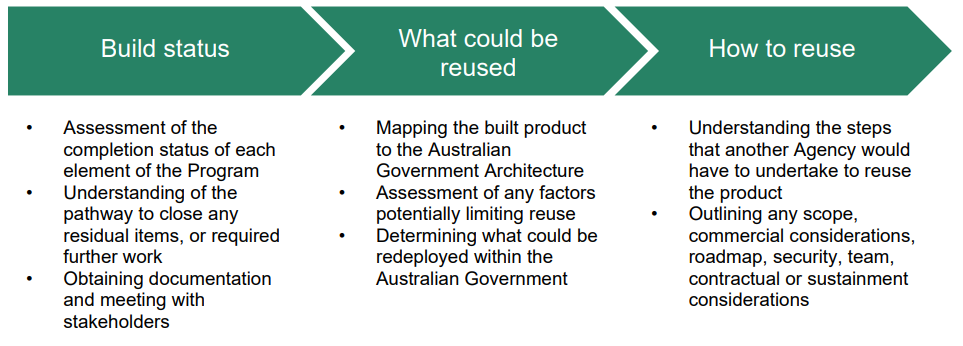
The approach developed to undertake the reuse assessment is outlined in the figure below.
Figure 1: Approach phases
Figure 3 image description
Figure 3: Reuse hierarchy
Use of what is already built
Full Copy Shared Service Portal Access
Building on something that exists
Separate instance
Limited Customisation & Configuration
Repository
Learnings & Thought Leadership
Business Capability & Processes
Designs, Blueprints & Patterns
Off
Figure 3: Reuse hierarchy
Use of what is already built
Full Copy Shared Service Portal Access
Building on something that exists
Separate instance
Limited Customisation & Configuration
Repository
Learnings & Thought Leadership
Business Capability & Processes
Designs, Blueprints & Patterns
2.4.4 How to reuse
This phase outlines the pragmatic considerations for reuse, including:
residual build requirements
implementation options, timeframes, and potential costs
All these factors are collectively assessed to determine the viability of reuse.
References
Per Decision 12 of the Decision Framework Briefing Outcomes of SSSC [Shared Services Sub-Committee], page 91.
Build and test information reported by Services Australia was based on the MVP1.1 template.
Changes made, grouped into Workflows, Report, Interfaces, Conversions, Enhancements, Forms – see Appendix G: Terms and definitions.
3. GovERP Overview
3.1 Initiation and intent
The whole of government Shared Services Program, led by the Department of Finance, commenced in 2014 with approval from the Secretaries Board.
The enabling technology for the Shared Services Program, GovERP, began in 2017 when the Department of Finance undertook a Request for Proposal for a whole of government ERP. The GovERP Program aimed to consolidate and standardise common transactional corporate Australian Public Service (APS) processes and services aiming for cost-effectiveness, scalability, and advancing the one-APS vision while enhancing Australia’s digital capability.
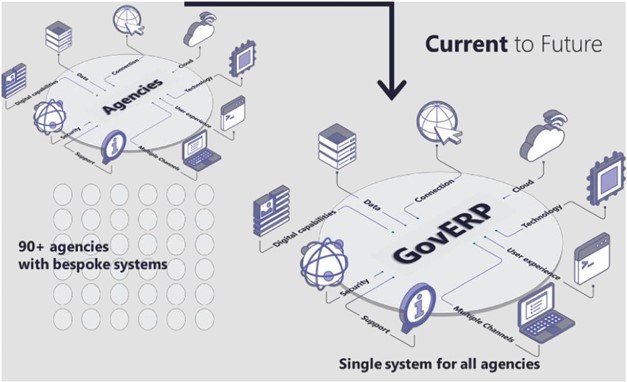
In contributing to the government’s digital transformation, GovERP was intended to improve day-to-day operations within government departments, facilitating smoother interactions between entities, thus streamlining the access to (and consumption of) corporate services within the APS. This intended future state is illustrated in Figure 4 below.
Figure 4: GovERP current to future state (see Reference 1)
Annual action and progress to achieve the vision of the Strategy.
4. Summary of delivered product
4.1 Overview
The current GovERP solution serves as an initial framework aimed at establishing the groundwork for future enhancements and deployments. The current solution was paused mid-flight in November 2023, and hence a number of capabilities are still under development, and all testing was not completed.
Figure 9 provides an overview of the build completeness of the MVP1.1 build in terms of both value stream and functional capability.
Correspondence from DTA CEO to Services Australia CEO, 20 May 2024 sharing preliminary observations and insights of the Assessment
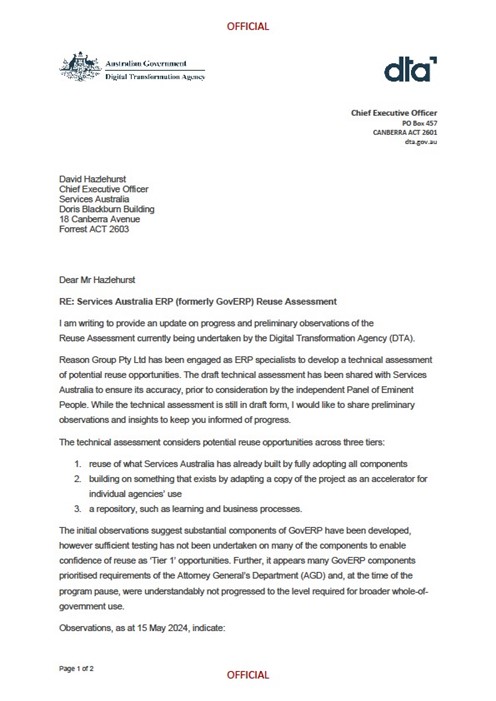
This letter appears on Digital Transformation Agency letterhead and comes from the CEO.
Dear Mr Hazlehurst,
RE: Services Australia ERP (formerly GovERP Reuse Assessment)
I am writing to provide an update on progress and preliminary observations of the Reuse Assessment currently being undertaken by the Digital Transformation Agency (DTA).
Reason Group Pty Ltd has been engaged as ERP specialists to develop a technical assessment of potential reuse opportunities. The draft technical assessment has been shared with Services Australia to ensure its accuracy, prior to consideration by the independent Panel of Eminent People. While the technical assessment is still in draft form, I would like to share preliminary observations and insights to keep you informed of progress.
The technical assessment considers potential reuse opportunities across three tiers:
reuse of what Services Australia has already built by fully adopting all components
building on something that exists by adapting a copy of the project as an accelerator for individual agencies' use
a repository, such as learning and business processes.
The initial observations suggest substantial components of GovERP have been developed, however sufficient testing has not been undertaken on many of the components to enable confidence of reuse as 'Tier 1' opportunities. Further, it appears many GovERP components prioritised requirements of the Attorney General's Department (AGD) and, at the time of the program pause, were understandably not progressed to the level required for broader whole-of-government use.
Observations, as at 15 May 2024, indicate:
of the 39 ERP functional capabilities scoped as a minimum viable product for AGD, 30 capabilities have been developed with a subset of these capabilities (18, or 46%) having completed functional testing.
69% of human capability management and 62% of financial management related capabilities have completed testing.
limited to no procurement-related and travel and expense management-related capabilities have been developed or tested (noting assessment is ongoing for these).
Initial analysis suggests cross-government Tier 1 reuse opportunities may be further limited from a commercial perspective for smaller agencies with less complex needs, particularly when considering 'choice' under the new APS ERP arrangements. Reusability could be appropriate for a specific implementation, or for a larger agency with more complex ERP needs such as Services Australia; I understand consideration of this is ongoing.
The assessment is likely to establish some reuse opportunities as potential accelerators or learnings for agencies ('Tier 2' and 'Tier 3' opportunities). Ideally, any reusable content from the Services Australia ERP can also be leveraged through the Australian Government Architecture. Examples of potential 'Tier 2' and 'Tier 3' reuse opportunities include:
the Travel and Expense Management tool, Expense8, which is currently used by approximately 40 entities
SAP Signavio, which houses a range of process maps and may be able to be utilised for other entity ERP developments.
Finally, it is fair to say that the evolving view will indicate that Tier 1 use of GovERP would be most likely to relate to implementation within your agency and possibly (but not confidently yet) to your connected agencies to which you currently provide services.
In this context, I look forward to continuing collaboration with you and your staff to support the new APS ERP approach. I would be happy to discuss the Reuse Assessment's observations and insights at your convenience, including the Eminent Panel’s potential findings and recommendations.
Kind regards
Chris Fechner
20 May 2024
Correspondence from the Minister for Government Services to the Minister for Finance, 26 April 2024 providing an update on the GovERP program
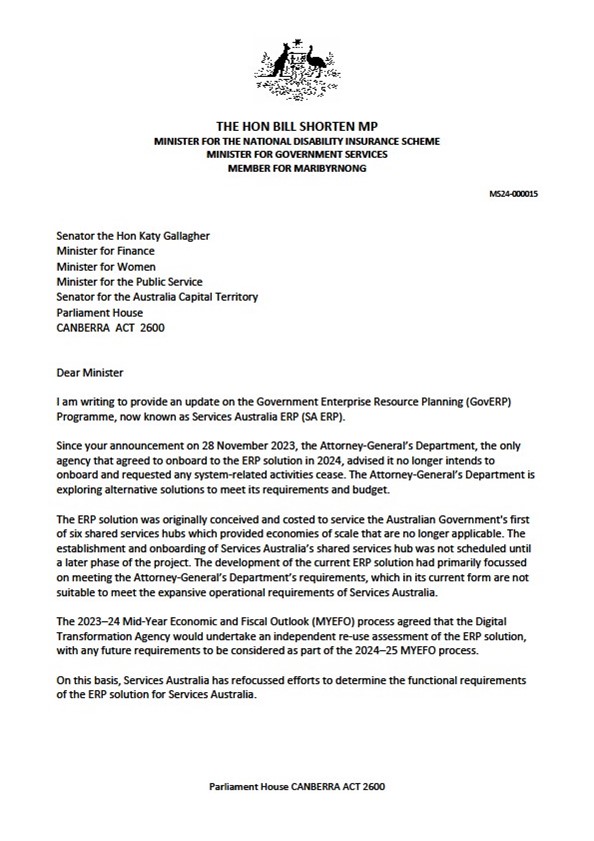
This letter appears on The Hon Bill Shorten MP's letterhead
The address on this letter reflects that it is written to Senator the Hon Katy Gallagher
Dear Minister
I am writing to provide an update on the Government Enterprise Resource Planning (GovERP) Programme, now known as Services Australia ERP (SA ERP). Since your announcement on 28 November 2023, the Attorney-General’s Department, the only agency that agreed to onboard to the ERP solution in 2024, advised it no longer intends to onboard and requested any system-related activities cease. The Attorney-General’s Department is exploring alternative solutions to meet its requirements and budget.
The ERP solution was originally conceived and costed to service the Australian Government’s first of six shared services hubs which provided economies of scale that are no longer applicable. The establishment and onboarding of Services Australia’s shared services hub was not scheduled until a later phase of the project. The development of the current ERP solution had primarily focussed on meeting the Attorney-General’s Department’s requirements, which in its current form are not suitable to meet the expansive operational requirements of Services Australia.
The mid 2023–2024 Mid-Year Economic and Fiscal Outlook (MYEFO) process agreed that the Digital Transformation Agency would undertake an independent re-use assessment of the ERP solution, with any future requirements to be considered as part of the 2024–25 MYEFO process.
On this basis, Services Australia has refocused efforts to determine the functional requirements of the ERP solution for Services Australia.
In February 2023, you agreed to reprofile $60 million of Services Australia’s original GovERP budget allocation to the 2023–24 financial year. As at 31 March 024, the Programme has spent $38.2 million of the Agency’s 2023-24 budget. The remaining budget will be used to continue sustainment of the current ERP solution, including ongoing licencing and hosting costs of the platform.
Correspondence from DTA CEO to Services Australia CEO, 20 May 2024 sharing preliminary observations and insights of the Assessment
This letter appears on Digital Transformation Agency letterhead and comes from the CEO.
Dear Mr Hazlehurst,
RE: Services Australia ERP (formerly GovERP Reuse Assessment)
I am writing to provide an update on progress and preliminary observations of the Reuse Assessment currently being undertaken by the Digital Transformation Agency (DTA).
Reason Group Pty Ltd has been engaged as ERP specialists to develop a technical assessment of potential reuse opportunities. The draft technical assessment has been shared with Services Australia to ensure its accuracy, prior to consideration by the independent Panel of Eminent People. While the technical assessment is still in draft form, I would like to share preliminary observations and insights to keep you informed of progress.
The technical assessment considers potential reuse opportunities across three tiers:
reuse of what Services Australia has already built by fully adopting all components
building on something that exists by adapting a copy of the project as an accelerator for individual agencies' use
a repository, such as learning and business processes.
The initial observations suggest substantial components of GovERP have been developed, however sufficient testing has not been undertaken on many of the components to enable confidence of reuse as 'Tier 1' opportunities. Further, it appears many GovERP components prioritised requirements of the Attorney General's Department (AGD) and, at the time of the program pause, were understandably not progressed to the level required for broader whole-of-government use.
Observations, as at 15 May 2024, indicate:
of the 39 ERP functional capabilities scoped as a minimum viable product for AGD, 30 capabilities have been developed with a subset of these capabilities (18, or 46%) having completed functional testing.
69% of human capability management and 62% of financial management related capabilities have completed testing.
limited to no procurement-related and travel and expense management-related capabilities have been developed or tested (noting assessment is ongoing for these).
Initial analysis suggests cross-government Tier 1 reuse opportunities may be further limited from a commercial perspective for smaller agencies with less complex needs, particularly when considering 'choice' under the new APS ERP arrangements. Reusability could be appropriate for a specific implementation, or for a larger agency with more complex ERP needs such as Services Australia; I understand consideration of this is ongoing.
The assessment is likely to establish some reuse opportunities as potential accelerators or learnings for agencies ('Tier 2' and 'Tier 3' opportunities). Ideally, any reusable content from the Services Australia ERP can also be leveraged through the Australian Government Architecture. Examples of potential 'Tier 2' and 'Tier 3' reuse opportunities include:
the Travel and Expense Management tool, Expense8, which is currently used by approximately 40 entities
SAP Signavio, which houses a range of process maps and may be able to be utilised for other entity ERP developments.
Finally, it is fair to say that the evolving view will indicate that Tier 1 use of GovERP would be most likely to relate to implementation within your agency and possibly (but not confidently yet) to your connected agencies to which you currently provide services.
In this context, I look forward to continuing collaboration with you and your staff to support the new APS ERP approach. I would be happy to discuss the Reuse Assessment's observations and insights at your convenience, including the Eminent Panel’s potential findings and recommendations.
Kind regards
Chris Fechner
20 May 2024
Correspondence from the Minister for Government Services to the Minister for Finance, 26 April 2024 providing an update on the GovERP program
This letter appears on The Hon Bill Shorten MP's letterhead
The address on this letter reflects that it is written to Senator the Hon Katy Gallagher
Dear Minister
I am writing to provide an update on the Government Enterprise Resource Planning (GovERP) Programme, now known as Services Australia ERP (SA ERP). Since your announcement on 28 November 2023, the Attorney-General’s Department, the only agency that agreed to onboard to the ERP solution in 2024, advised it no longer intends to onboard and requested any system-related activities cease. The Attorney-General’s Department is exploring alternative solutions to meet its requirements and budget.
The ERP solution was originally conceived and costed to service the Australian Government’s first of six shared services hubs which provided economies of scale that are no longer applicable. The establishment and onboarding of Services Australia’s shared services hub was not scheduled until a later phase of the project. The development of the current ERP solution had primarily focussed on meeting the Attorney-General’s Department’s requirements, which in its current form are not suitable to meet the expansive operational requirements of Services Australia.
The mid 2023–2024 Mid-Year Economic and Fiscal Outlook (MYEFO) process agreed that the Digital Transformation Agency would undertake an independent re-use assessment of the ERP solution, with any future requirements to be considered as part of the 2024–25 MYEFO process.
On this basis, Services Australia has refocused efforts to determine the functional requirements of the ERP solution for Services Australia.
In February 2023, you agreed to reprofile $60 million of Services Australia’s original GovERP budget allocation to the 2023–24 financial year. As at 31 March 024, the Programme has spent $38.2 million of the Agency’s 2023-24 budget. The remaining budget will be used to continue sustainment of the current ERP solution, including ongoing licencing and hosting costs of the platform.
Yours sincerely Bill Shorten 26 April 2024
Accessible Appendix F (Text version)
Appendix F:MVP capabilities for GovERP
Shared Services Steering Committee-agreed MVP 1.0 capabilities for whole-of-government purposes
The table above contains the following information:
1. Hire to retire
Developed and functionally tested
• Learning management • Leave and absence management • Organisational management • Performance and goals management • Recruitment • On-boarding • Off-boarding • Work time and attendance • Time sheet recording and management
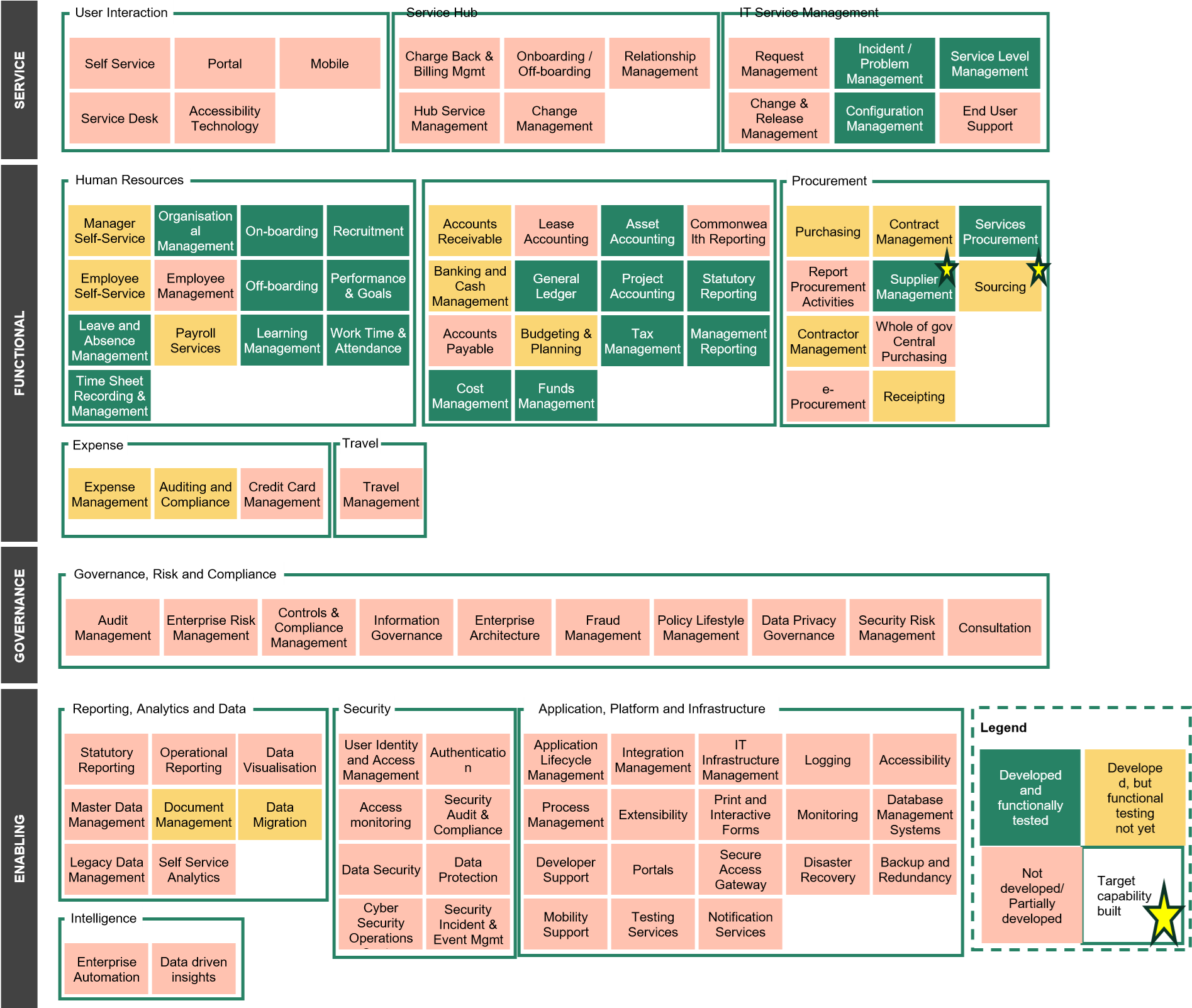
A complex diagram showing Services Australia-developed MVP1.1 functional capabilities. There are four main areas: service, functional, governance and enabling. These categories are then split into subcategories, which have a number of capabilities. These capabilities are then identified as either
Developed and functionally tested, which has been shortened to ‘developed’
Developed, but functional testing not yet, which has been shortened to ‘not tested’
Not developed/partially developed, which has been shortened to ‘not complete’
The contents of the diagram follow as a list. Each of the four main areas is divided into its subcategories, which then list the individual capabilities and their current status.
The diagram also shows two capabilities as ‘Target capability’ built. These are supplier management and sourcing in procurement under ‘Functional’ capabilities.
Service
User interaction
Self Service – not complete
Service Desk – not complete
Accessibility Technology – not complete
Portal – not complete
Mobile – not complete
Service hub
Charge Back & Billing Management – not complete
Onboarding / Off-boarding – not complete
Relationship Management – not complete
Hub service management – not complete
Change management – not complete
IT service management
Request Management – not complete
Incident / Problem Management – developed
Service Level Management – developed
Change & Release Management – not complete
Configuration Management – developed
End User Support – not complete
Functional
Human Resources
Manager Self-Service – not tested
Employee Self-Service – not tested
Leave and Absence Management – developed
Time Sheet Recording & Management – developed
Organisational Management – developed
Employee Management – not complete
Payroll Services – not tested
On-boarding – developed
Off-boarding – developed
Learning Management – developed
Recruitment – developed
Performance & Goals – developed
Work Time & Attendance – developed
Finance
Accounts Receivable – not tested
Banking and Cash Management – not tested
Accounts Payable – not complete
Cost Management – developed
Lease accounting – not complete
General Ledger – developed
Budgeting & Planning – not tested
Funds Management – developed
Asset accounting – developed
Project accounting – developed
Tax management – developed
Commonwealth reporting – not complete
Statutory reporting – developed
Management reporting – developed
Expense
Expense Management – not tested
Auditing and Compliance – not tested
Credit Card Management – not complete
Travel
Travel Management – not complete
Procurement
Purchasing – not tested
Report Procurement activities – not complete
Contractor management – not tested
eProcurement – not complete
Contract Management – not tested
Supplier Management – developed
Whole-of-government central purchasing – not complete
Receipting – not tested
Services procurement – developed
Sourcing – not tested
Governance
Governance, Risk and Compliance
Audit Management – not complete
Enterprise Risk Management – not complete
Controls & Compliance Management – not complete
Information Governance – not complete
Enterprise Architecture – not complete
Fraud Management – not complete
Policy Lifecycle Management – not complete
Data Privacy Governance – not complete
Security Risk Management – not complete
Consultation – not complete
Enabling
Reporting, Analytics and Data
Statutory Reporting – not complete
Master Data Management – not complete
Legacy Data Management – not complete
Operational Reporting –– not complete
Document Management – not tested
Self Service Analytics – not complete
Data Visualisation – not complete
Data Migration – not tested
Security
User Identity and Access Management – not complete
Authentication – not complete
Access monitoring – not complete
Security Audit & Compliance – not complete
Data Security – not complete
Data Protection – not complete
Cyber Security Operations Centre (SOC) – not complete
Security Incident & Event Management – not complete
Application, Platform and Infrastructure
Application Lifecycle Management – not complete
Integration Management – not complete
IT Infrastructure Management – not complete
Logging – not complete
Accessibility – not complete
Process Management – not complete
Extensibility – not complete
Print and Interactive Forms – not complete
Monitoring – not complete
Database Management Systems – not complete
Developer Support – not complete
Portals – not complete
Secure Access Gateway – not complete
Disaster Recovery – not complete
Backup and Redundancy – not complete
Mobility Support – not complete
Testing Services – not complete
Notification Services – not complete
Intelligence
Enterprise Automation – not complete
Data driven Insights – not complete
Off
Appendix F:MVP capabilities for GovERP
Shared Services Steering Committee-agreed MVP 1.0 capabilities for whole-of-government purposes
The table above contains the following information:
1. Hire to retire
Developed and functionally tested
• Learning management • Leave and absence management • Organisational management • Performance and goals management • Recruitment • On-boarding • Off-boarding • Work time and attendance • Time sheet recording and management
A complex diagram showing Services Australia-developed MVP1.1 functional capabilities. There are four main areas: service, functional, governance and enabling. These categories are then split into subcategories, which have a number of capabilities. These capabilities are then identified as either
Developed and functionally tested, which has been shortened to ‘developed’
Developed, but functional testing not yet, which has been shortened to ‘not tested’
Not developed/partially developed, which has been shortened to ‘not complete’
The contents of the diagram follow as a list. Each of the four main areas is divided into its subcategories, which then list the individual capabilities and their current status.
The diagram also shows two capabilities as ‘Target capability’ built. These are supplier management and sourcing in procurement under ‘Functional’ capabilities.
Service
User interaction
Self Service – not complete
Service Desk – not complete
Accessibility Technology – not complete
Portal – not complete
Mobile – not complete
Service hub
Charge Back & Billing Management – not complete
Onboarding / Off-boarding – not complete
Relationship Management – not complete
Hub service management – not complete
Change management – not complete
IT service management
Request Management – not complete
Incident / Problem Management – developed
Service Level Management – developed
Change & Release Management – not complete
Configuration Management – developed
End User Support – not complete
Functional
Human Resources
Manager Self-Service – not tested
Employee Self-Service – not tested
Leave and Absence Management – developed
Time Sheet Recording & Management – developed
Organisational Management – developed
Employee Management – not complete
Payroll Services – not tested
On-boarding – developed
Off-boarding – developed
Learning Management – developed
Recruitment – developed
Performance & Goals – developed
Work Time & Attendance – developed
Finance
Accounts Receivable – not tested
Banking and Cash Management – not tested
Accounts Payable – not complete
Cost Management – developed
Lease accounting – not complete
General Ledger – developed
Budgeting & Planning – not tested
Funds Management – developed
Asset accounting – developed
Project accounting – developed
Tax management – developed
Commonwealth reporting – not complete
Statutory reporting – developed
Management reporting – developed
Expense
Expense Management – not tested
Auditing and Compliance – not tested
Credit Card Management – not complete
Travel
Travel Management – not complete
Procurement
Purchasing – not tested
Report Procurement activities – not complete
Contractor management – not tested
eProcurement – not complete
Contract Management – not tested
Supplier Management – developed
Whole-of-government central purchasing – not complete
Receipting – not tested
Services procurement – developed
Sourcing – not tested
Governance
Governance, Risk and Compliance
Audit Management – not complete
Enterprise Risk Management – not complete
Controls & Compliance Management – not complete
Information Governance – not complete
Enterprise Architecture – not complete
Fraud Management – not complete
Policy Lifecycle Management – not complete
Data Privacy Governance – not complete
Security Risk Management – not complete
Consultation – not complete
Enabling
Reporting, Analytics and Data
Statutory Reporting – not complete
Master Data Management – not complete
Legacy Data Management – not complete
Operational Reporting –– not complete
Document Management – not tested
Self Service Analytics – not complete
Data Visualisation – not complete
Data Migration – not tested
Security
User Identity and Access Management – not complete
Authentication – not complete
Access monitoring – not complete
Security Audit & Compliance – not complete
Data Security – not complete
Data Protection – not complete
Cyber Security Operations Centre (SOC) – not complete
Security Incident & Event Management – not complete
Application, Platform and Infrastructure
Application Lifecycle Management – not complete
Integration Management – not complete
IT Infrastructure Management – not complete
Logging – not complete
Accessibility – not complete
Process Management – not complete
Extensibility – not complete
Print and Interactive Forms – not complete
Monitoring – not complete
Database Management Systems – not complete
Developer Support – not complete
Portals – not complete
Secure Access Gateway – not complete
Disaster Recovery – not complete
Backup and Redundancy – not complete
Mobility Support – not complete
Testing Services – not complete
Notification Services – not complete
Intelligence
Enterprise Automation – not complete
Data driven Insights – not complete
1. Executive Summary
The Digital Transformation Agency (DTA) engaged Reason Group to prepare this report which provides an in-depth technical assessment of the Australian Government's Enterprise Resource Planning (GovERP) technology platform, with a particular focus on its potential for reuse by other government entities. The report is intended to support and inform a Panel of Eminent People appointed by the DTA to evaluate the suitability of GovERP (see Reference 1) use by Services Australia, and potential reuse by other Commonwealth entities to support their implementation of future costeffective ERP uplifts.
The assessment considers (see Reference 2) various aspects, including the current state of GovERP by value stream, which encompass critical business functions such as Human Resources, Finance, Procurement, and Travel and Expense Management. Its readiness for reuse, identification of reusable components, and considerations for implementation by other entities have been assessed within this report. The assessment highlights the progress made in GovERP’s development, comparing the original intended full solution (or capabilities) with what was built by Services Australia (see Reference 3) at the point of the project’s pause. Reason Group are also aware of a number of project decisions and change requests, however, this assessment is not litigating these but rather considering the current state for reusability.
The build status for core capabilities as per the intended full solution and Minimum Viable Product (MVP) scope is summarised in the below table. For the Service, Governance and Enabling layers, many capabilities were paused when decisions were made to move away from the original GovERP operating model.
In respect of the Governance and Enabling layers, these were specific to the Shared Services operating model, so are not considered relevant for reuse. Further, all components of the Services layer were deemed out of scope of this assessment (see Reference 5).
A breakdown on the value streams of GovERP is summarised below.
Table 2: Capability build status for value streams
Based on the current build status, environmental considerations around data, integration and hosting, reuse has been conceptualised at three distinct levels:
Tier 1: Use of what is already built by fully adopting all components within a specific product.
Tier 2: Building on something that exists by adapting a copy of the product as an accelerator for individual entities to use.
Tier 3: Repository, such as learnings, business processes.
The table below summarises the core components which are reusable from GovERP.
Table 3: Value stream and/or technology reusability summary
Value stream
Technology
Tier 1
Tier 2
Tier 3
Hire to Retire (H2R)
SAP Success Factors
not reusable
reusable
reusable
Finance, including Revenue to Bank (R2B) and Budget to Report (B2R)
As part of this assessment, SAP provided advice there is nothing visible in the core solution which limit supportability or reuse, and that the standard code included no changes (see Reference 9).
In addition, there are 17 other technology (see Reference 10) components that are used in the end-to-end GovERP solution, that may provide accelerators for entities who adopt (or adapt) to the above SAP technologies.
While GovERP shows promise as a solution for large entities like Services Australia, with potential benefits for accelerating their ERP journey, it may present capacity and budgetary challenges for smaller entities. Alternative service models or technology solutions should be considered by smaller entities.
Moreover, the completeness of the GovERP build suggests it may not yet be ready for adoption by other entities. Further testing, refinement and completion of missing components are necessary to ensure any component could be suitable for reuse. Services Australia emerges as the logical entity to complete the component build, given the complexity of their ERP requirements, and the current hosting solution for the product, compared to smaller entities in the Commonwealth.
Looking ahead, if the components of GovERP achieve maturity and completeness, it could serve as an effective accelerator pattern for other larger entities seeking to modernise their respective ERP systems. However, careful consideration of agency-specific factors and requirements will be essential to maximise the potential benefits of GovERP’s reuse across the government sector.
References
Now known as Services Australia ERP.
This report excludes assessment of:
GovERP’s original business case validity
the appropriateness of the agreed scope of the Minimum Viable Product (MVP)
analysis of factors leading to the GovERP Program’s pause in November 2023
comparisons of process and architecture to any existing Government entities
detailed costings related to implementation
future customisation / configuration and data migration requirements due to agency-specific factors.
The report refers to Minimum Viable Product 1.1 (MVP1.1) when referring to what Services Australia has built. This includes any capabilities which were expected to be built as part of the initially defined MVP, however, were later deprioritised during delivery of GovERP.
Built means development has occurred, and functional testing has been conducted. Full system integration testing (SIT) and user acceptance testing (UAT) have not been undertaken.
Refer to section 2.2 for further information on the scope.
“Supplier Management” was not in scope of MVP1.1. However, Services Australia built and functionally tested this capability.
The vendor, 8common, advised all build elements were completed and tested, however, these were not integrated by Services Australia as part of the GovERP solution.
While the development and testing of TEMS is not completed, this relates to the integration of Expense8 to S/4HANA. In isolation, Expense8 is reusable and has been integrated into several other technologies, including SAP ECC6 and TechnologyOne within other entities in the Australian Government.
SAP Australia, Supportability and GovERP reuse for Services Australia, 11 April 2024.
Further details provided in section 5.7 and Appendix A.
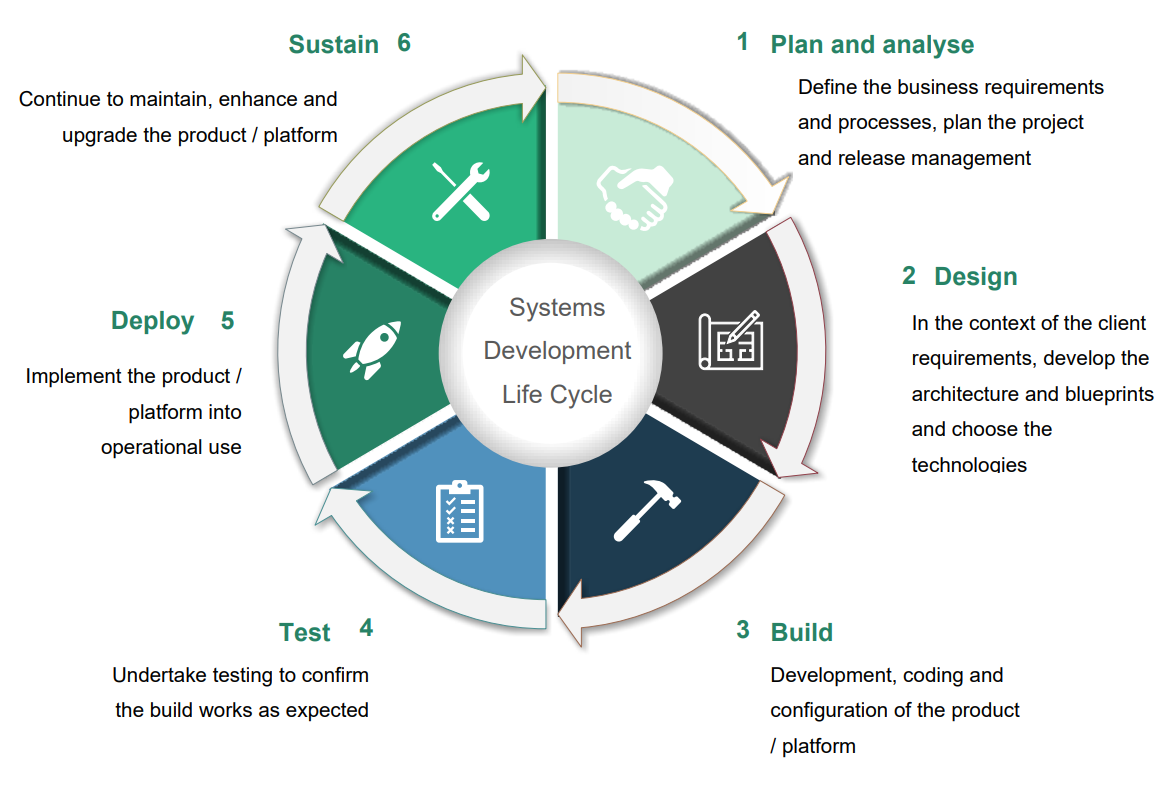
This phase examines the current state of the GovERP system’s construction. Technical capabilities are evaluated based on a standard system development lifecycle, with an assessment of each capability’s progress.
Figure 2: Systems development life cycle
Within GovERP, three templates exist:
MVP1.0: The ‘full’ GovERP solution, and the initial template as per Decision 12 (see Reference 1) outlining the MVP, which is assessed within this report.
MVP1.1: This is the agreed template that was being developed by Services Australia at the time of GovERP pause, which is assessed within this report (see Reference 2).
MVP1.1 with AGD enhancements: This was the template, developed for AGD, which incorporates specific requirements identified during implementation discovery.
For the purposes of this assessment:
MVP build assessment: The assessment has focused on the build of MVP1.1. The build status against MVP1.1 with AGD enhancement has not been explicitly considered, however, any changes from the base product (i.e. WRICEFs) (see Reference 3) have been included for visibility.
definition of built: Built means development has occurred, and functional testing has been conducted. As agreed with Services Australia, where functional testing was not completed, the build status has been listed as not built. Note, no system integration testing (SIT) or user acceptance testing (UAT) was conducted as part of GovERP, which are required prior to deployment into a production environment.
Further, assessment against the following dimensions of the build completeness has been conducted:
value streams and processes: Evaluates the business perspective of developed components for potential application in other entities’ organisational needs.
functional capabilities: Reviews a technical capability and outlines the architectural development of the product.
customisation and configuration: Analyses specific enhancements made to the base products to understand the deviations from the standard ‘out-of-the-box’ configuration, known as WRICEFs. In respect of the WRICEFs, each have been assessed on the below scale of effort to maintain:
low – Configuration changes only.
medium – Development support required to adjust code (e.g. Business Add-in) and support enhancements.
high – Full development support required (e.g. solutions implemented via SAP note where code has been written).
data and security: Highlights key security and data storage information essential for understanding GovERP’s foundational elements.
The evidence gathered throughout the review can be categorised into three main areas:
cite: The assessment team has observed and validated relevant aspects of the system.
documented: Documentary evidence provided (e.g. test reports, Gateway reports,technical specifications).
interviews: Discussions with, or testimonials from, key stakeholders.
To understand the current state of the GovERP build, extensive research has been conducted, including:
document review: architecture artefacts, build and test reports, technical specifications.
interviews: discussions with technical and business leads from Services Australia.
vendor engagement: interactions with SAP and 8common.
external agency engagement: AGD, Department of Finance and Department of Defence.
2.4.3 Potential for reuse
This phase is concentrated on identifying concrete opportunities for reuse within GovERP. The concept of reuse has been broadly interpreted, encompassing the use of existing technology and leveraging pre-existing processes or patterns. Nonetheless, to reuse something is to make use of it more than once for a different purpose, or for a subsequent time.
The Digital and ICT Reuse Policy outlines three high-level requirements for reuse:
reuse whenever possible – proposed investments must plan for and make use of any opportunities to reuse existing services or tools within your agency and across government.
design and build for reuse – if a proposed investment cannot reuse an existing digital or ICT solution, the proposed investment must ensure that the service built can be reused by other agencies.
enable reuse by others – ensure anything created is shared for others to reuse unless there’s a good reason not to.
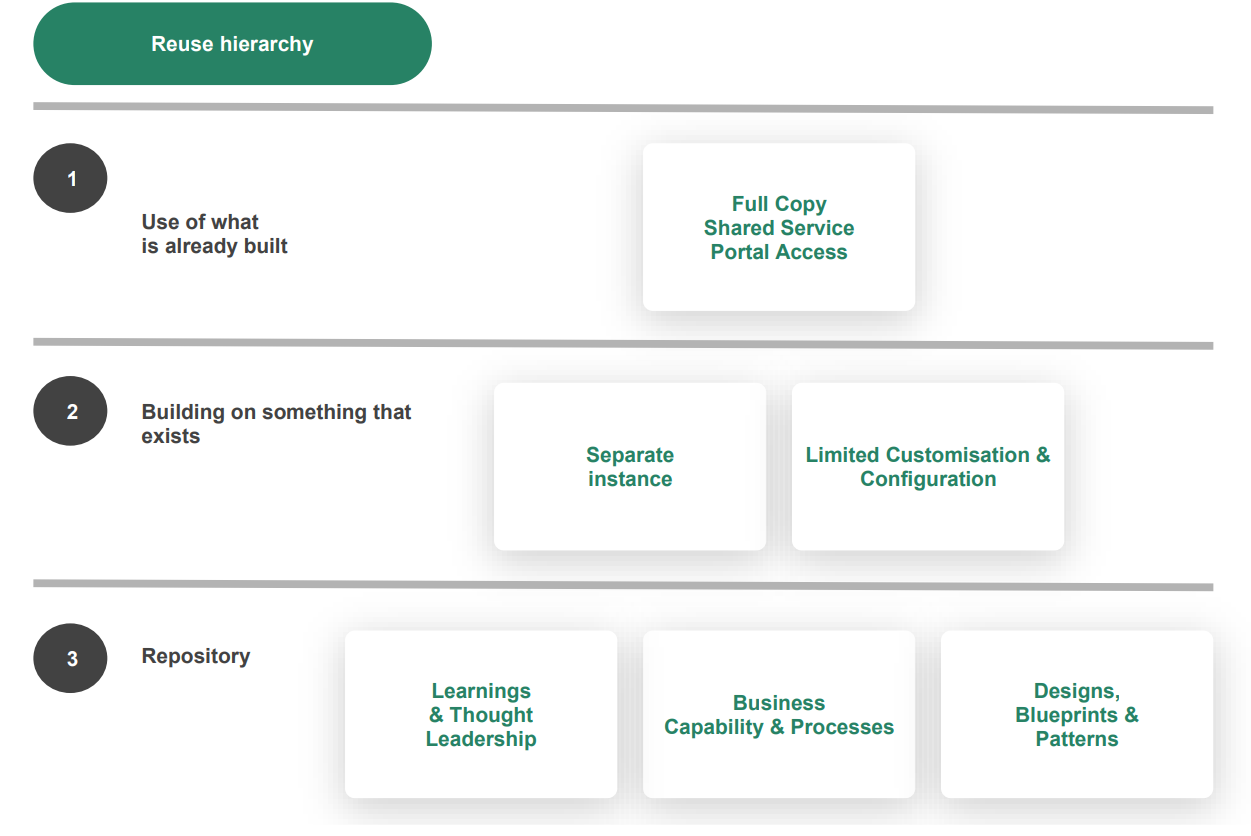
Based on the policy, the current build status, environmental considerations around data, integration and hosting, reuse has been conceptualised at three distinct levels:
Tier 1: Use of what is already built by fully adopting all components within a specific product.
Tier 2: Building on something that exists by adapting a copy of the product as an accelerator for individual entities use.
Tier 3: Repository, such as learnings, business processes.
These three levels are shown in the figure below.
Figure 3: Reuse hierarchy
Connect with the digital community
Share, build or learn digital experience and skills with training and events, and collaborate with peers across government.